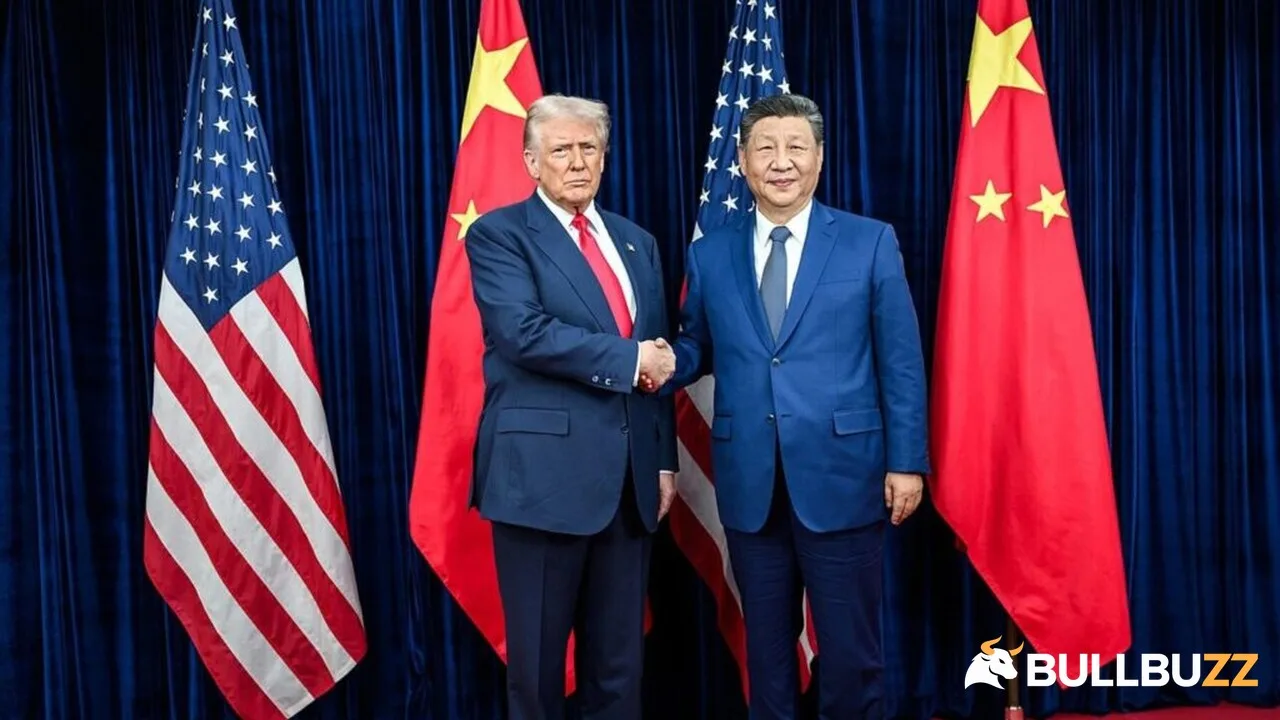
The Trump Xi trade deal agreed in Busan cuts United States tariffs on Chinese goods to 47% from 57%, pauses Beijing's rare-earth export controls for a year and restarts large American farm purchases, after a meeting the US president rated a "12 out of 10". Donald Trump and Xi Jinping met for about one hour and 40 minutes on Thursday at Gimhae International Airport in the South Korean city of Busan, their first face-to-face meeting since 2019, on the sidelines of Asia-Pacific Economic Cooperation gatherings, according to Reuters.
The centrepiece of the Trump Xi trade deal is a 10-point tariff cut. Trump told reporters aboard Air Force One that he had agreed to halve the 20% tariff imposed over China's role in fentanyl precursor chemicals to 10%, and China confirmed that takes average tariffs on its goods to 47%, down from 57%, the Associated Press reported. The two sides also agreed to keep working together on cracking down on illicit flows of the drug into the United States, which Trump said Xi would work "very hard" to stop.
For manufacturers and technology firms, the rare-earths commitment may matter even more than the tariff arithmetic. China agreed to pause export controls unveiled this month on rare earths, elements vital to cars, planes and weapons and Beijing's most potent trade-war leverage, Reuters reported. China's commerce ministry said the pause would last for a year. Trump had earlier threatened a 100% import tax over China's rare-earth restrictions; after the meeting he said that roadblock was gone.
American farmers were the other clear winners from the session. Trump said China had committed to buying "a tremendous amount" of American soybeans, sorghum and other farm products, the Associated Press reported. US Treasury Secretary Scott Bessent later put numbers on that commitment: China agreed to buy 25 million metric tons of US soybeans a year, starting with 12 million metric tons between now and January. Beijing curbed US farm exports after Trump began raising tariffs in January, and cutbacks in soybean, beef and other purchases have hit US farmers hard.
Trump Xi trade deal: what else was agreed in Busan
The two sides also agreed to pause tit-for-tat port fees on shipping, designed to thwart dominance in shipbuilding, ocean freight and logistics. Trump said China would begin the process of purchasing US energy, hinting at a possible Alaska liquefied natural gas deal. The two sides reached consensus on expanding agricultural trade and would work to resolve issues around short video app TikTok, which Trump seeks to bring under US-controlled ownership, although officials gave no details of progress on TikTok itself.
What the Busan truce does not settle
For all the upbeat language, the agreement is a truce, not a final settlement, and analysts quoted in both reports urged caution. The first official Chinese comments on the meeting were less specific than Trump's account and suggested any trade deal is not done. Other tariff increases remain in place, and the two sides have simply extended a truce on even steeper increases that began in May, when they agreed to allow time to work on a framework for resolving trade tensions.
Two of the most sensitive issues were not resolved at all. Trump said he did not discuss Nvidia's state-of-the-art Blackwell chip with Xi, and the contentious issue of Taiwan, the democratic island claimed by China, also did not surface in the talks. Trump said China would speak with Nvidia about purchasing computer chips, but not the Blackwell chip. Minutes before the meeting began, Trump also ordered the US military to resume testing nuclear weapons after a gap of 33 years, pointing to the growing arsenals of Russia and China; China's foreign ministry said it hoped Washington would stick to a moratorium on nuclear testing.
Why markets reacted with caution, not celebration
The market reaction to the detente was muted, a telling contrast with Trump's enthusiastic characterisation of the meeting. Major Asian indexes and European futures swung between gains and losses, China's Shanghai Composite slipped from a 10-year high, and US soybean futures were weaker, Reuters reported. "The response from markets has been cautious," Besa Deda, chief economist at advisory firm William Buck in Sydney, said. World markets had hit records before the meeting on hopes of a breakthrough in a trade war that has disrupted supply chains and shaken business confidence.
That caution fits the wider mood of the week. Wall Street's tech sell-off on Friday showed how quickly sentiment can turn when investors doubt the payoff from heavy spending, while gold fell below $3,900 as energy costs and rate expectations hardened. A tariff truce removes one source of uncertainty for exporters and importers, but it does not by itself restore the confidence that supply chains, farm incomes and factory orders depend on.
For traders watching Asia, the next test is implementation rather than announcement. China's factory activity has already slipped back into contraction, so the value of the Busan agreement will be measured in whether rare-earth shipments actually flow, soybean cargoes actually sail and the tariff cut actually shows up in landed costs. If those things happen, the meeting in Busan will be remembered as the moment the world's two largest economies stepped back from the brink. If they do not, it will be remembered as another fragile pause in a trade war whose root causes remain unresolved.