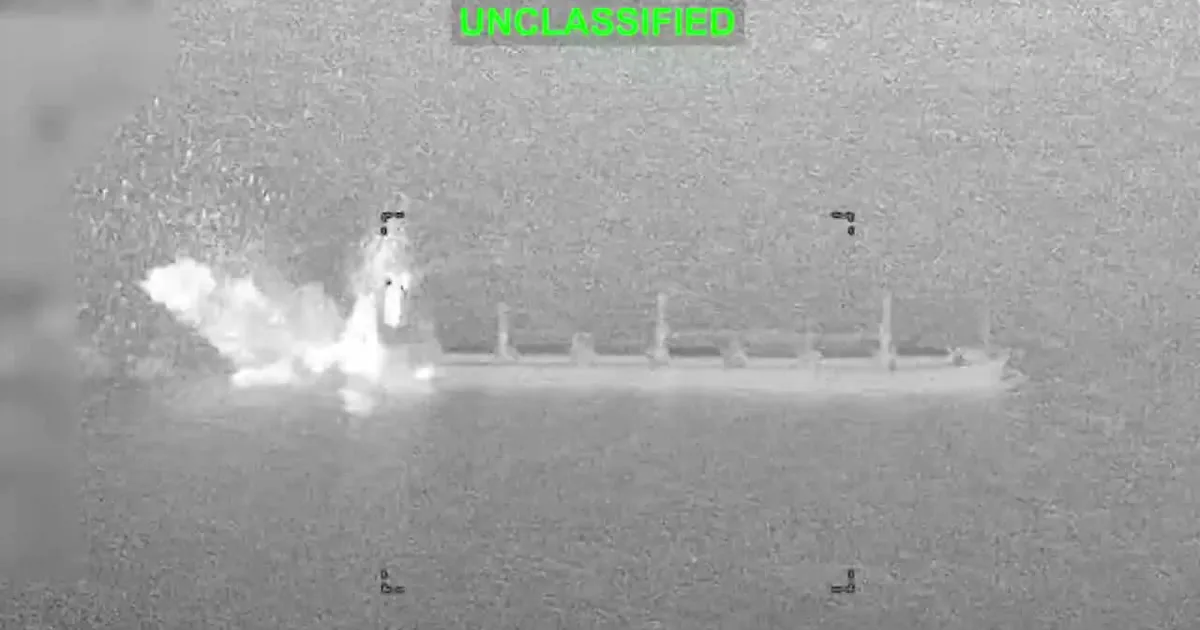
A US fighter jet struck a Panama-flagged cargo ship in the Gulf of Oman on 10 October, disabling its propulsion as Washington enforced a blockade of Iranian ports. US Central Command (CENTCOM) said no crew members were hurt. Its account of the vessel ignoring warnings has not been independently confirmed by the ship's operator.
The vessel was the M/V Ocean Molica, also known as the Arika Sun. CENTCOM said it had left an Iranian port before the strike. The incident puts another commercial ship at the centre of the Gulf shipping crisis, alongside the tanker attacks BullBuzz covered in its recent Hormuz tanker report.
What Happened to the Cargo Ship in the Gulf of Oman?
According to CENTCOM’s 10 October statement, the crew ignored repeated warnings and attempted to pass through the US naval blockade. A fighter jet then struck the ship's stern with a precision munition, leaving it unable to propel itself. The command said the crew was unharmed.
The military has released video of the strike, but the footage does not establish what warnings the crew received or what cargo was aboard. Reuters reported that it could not immediately reach the bulk carrier's operator for comment. No independent account from the crew or operator was available in the reports reviewed for this article.
CENTCOM said US forces resumed a blockade of vessels entering or leaving Iranian ports on 14 July. It counted four commercial vessels disabled and 135 turned around during three months of enforcement. Those figures are the military's own tally.
Why the Gulf of Oman Strike Matters for Shipping
The Gulf of Oman lies outside the Strait of Hormuz, the narrow passage linking the Persian Gulf to the Arabian Sea. A ship coming from an Iranian port can encounter US blockade forces as it moves towards open water. CENTCOM urged mariners in the Gulf of Oman and Hormuz approaches to monitor notices to mariners and contact US naval forces on bridge-to-bridge channel 16.
The risk is wider than this one vessel. UK Maritime Trade Operations has recorded separate projectile incidents affecting tankers in the Strait of Hormuz. Those reports should not be confused with the US strike on the Ocean Molica: the vessels and the reported attackers differ. The Associated Press also placed the cargo-ship strike in its account of a wider weekend of regional fighting.
What Does It Mean for Oil and Asian Markets?
The Strait of Hormuz handled about 20.9 million barrels a day of oil in the first half of 2025, roughly one-fifth of global petroleum-liquids consumption, according to the US Energy Information Administration. That is a pre-war benchmark, not a measure of current flows. Reuters said tanker transits recently fell to their lowest level in more than two months amid attacks and disruption.
For importers in Asia, including Malaysia, further vessel diversions can raise uncertainty over delivery times and shipping costs. The strike alone does not establish a new oil-price move. BullBuzz's earlier Brent price coverage explains how Hormuz risk has already fed into the market, while its Riyadh airport attack report tracks a separate escalation affecting regional transport.
What to Watch Next
Shipping operators will look for the vessel's own account, any statement from Panama as flag state, and updated navigation warnings. Traders will watch whether more ships are stopped or rerouted and whether actual Hormuz transit volumes change. Those developments, rather than the military's strike footage alone, will show how far the blockade is disrupting commercial traffic.
Image note: The article image is a still from video released by US Central Command of its reported 10 October strike on the M/V Ocean Molica. It was cropped for layout. The footage is a US military account of the event, not independent verification of the warnings or the ship's cargo. Source: CENTCOM video.