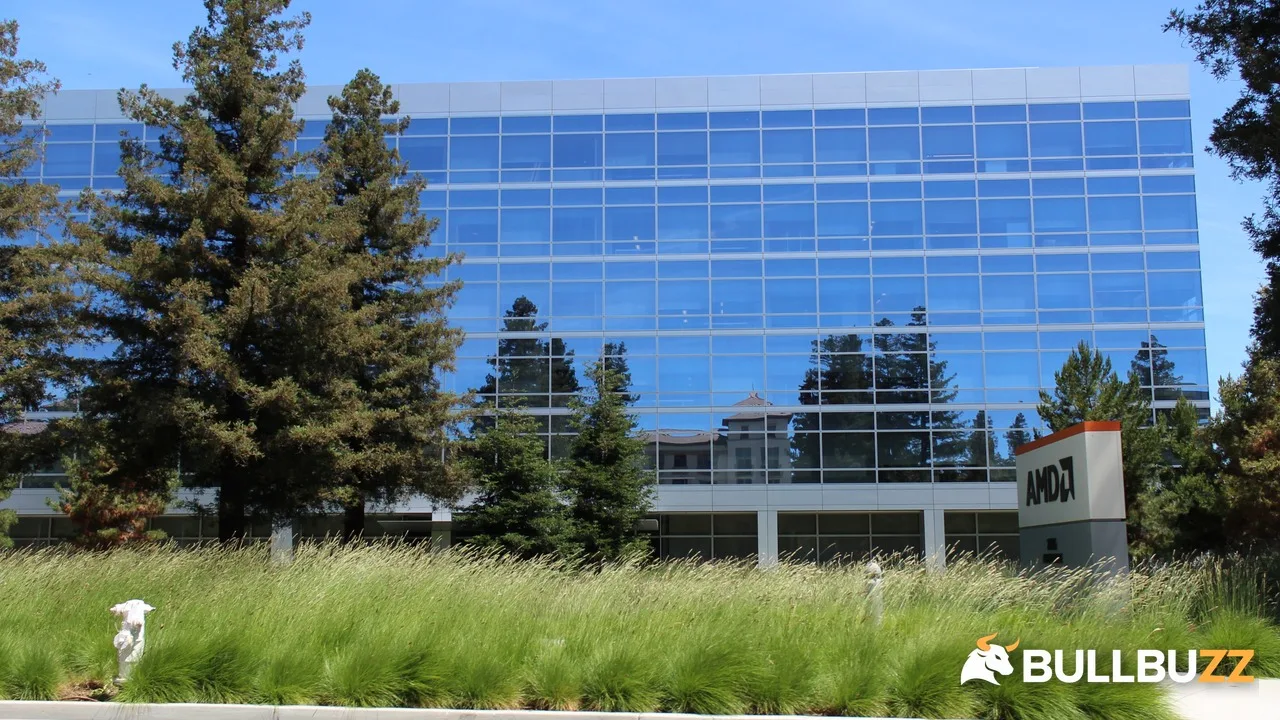
AMD stock jumped 8% in extended trading on Tuesday after Advanced Micro Devices forecast revenue growth of more than 80% in 2027, a projection that pushed back against mounting fears that the artificial-intelligence boom is losing steam. Reuters reported that the chipmaker's forecast, delivered alongside market-beating third-quarter results, sent its shares higher after the close and lifted rivals across the semiconductor sector.
The forecast matters because it arrived at a moment of doubt. Investors had spent recent weeks questioning whether AI infrastructure spending could keep justifying stretched valuations, and rival Intel's weak outlook last week had deepened the unease. AMD's answer was a number far above what analysts had pencilled in: growth of more than 80% next year, against a consensus estimate of 77% compiled by LSEG, according to Reuters.
AMD stock: data-centre revenue nearly doubles
The third quarter itself was a clear beat. Revenue rose 45% from a year earlier to $13.38 billion, above estimates of $13.09 billion, Reuters reported, while adjusted profit came in at $2.09 per share against expectations of $1.95. Earnings Whispers put the same quarter at $13.377 billion in revenue and $2.09 in non-GAAP earnings per share, confirming the beat on both lines.
The engine was the data-centre division. Revenue there jumped 97% to a record $8.55 billion, beating estimates of $8.20 billion, and the segment now accounts for 64% of AMD's total sales, up from 47% a year ago. Chief executive Lisa Su told analysts that 80% of next year's sales will come from data-centre chips, which she said will drive the majority of the company's revenue and earnings growth.
Su also raised the bar on every part of the 2027 framework. Server revenue is expected to roughly double next year, data-centre AI revenue is expected to grow even faster than projected three months ago, and the data-centre segment should exceed 80% of total revenue. Coverage of the earnings call notes that Su described herself as very confident in data-centre growth in 2027, with the fourth quarter guided to about $17 billion in revenue, plus or minus 3%, above the average analyst estimate of $16.23 billion.
Helios ramp puts AMD deeper into Nvidia's territory
Behind the forecast is a shift in what AMD sells. The company has moved beyond standalone chips toward complete AI systems, and its flagship Helios rack, combining its MI455X accelerator with new Venice server chips, is in production with a larger ramp-up set for the fourth quarter, Reuters reported. Initial systems are being tested at Meta, and Earnings Whispers reported that Helios racks have begun revenue shipments to Anthropic, Meta, Microsoft, OpenAI and Oracle.
The market reaction spread quickly. Intel shares rose 2%, Nvidia climbed more than 1% and Broadcom advanced 1.2% after AMD's report, Reuters reported, a sharp contrast with the mood a day earlier, when BullBuzz reported on Asian stocks sliding on AI spending fears. AMD's numbers offered the counterpoint traders had been waiting for: evidence that demand for AI hardware is still accelerating, not fading.
That context matters for the wider tech trade. Just days ago, OpenAI cut its funding target in a sign that private AI valuations are being repriced, and Apple's earnings beat showed consumer hardware still holding up. AMD's report suggests the infrastructure side of the AI story has further to run, even as the funding side gets more selective.
The weak spots investors are watching
The report was not uniformly strong. Sales in the client and gaming segment, home to AMD's PC chips and console processors, fell 8% to $3.72 billion, missing estimates of $3.79 billion, Reuters reported. Management expects PC unit shipments to fall by a double-digit percentage next year, though Su said AMD would outperform the market, and Earnings Whispers noted gaming revenue fell 40% on the console cycle.
Cash is the other watch item. Free cash flow dropped to $554 million in the quarter, down from $1.6 billion in the second quarter and $2.6 billion in the first, while inventory swelled by roughly $3 billion to $11.5 billion, Earnings Whispers reported. The company also guided fourth-quarter adjusted gross margin to about 55%, down from 56% in the third quarter, as lower-margin AI systems become a larger share of sales.
None of that stopped the after-hours rally, partly because the stock had already fallen hard. Earnings Whispers noted AMD shares had dropped about 29% from their October 6 high of $658.52 to $466.84 heading into the report. The 2027 forecast reframes the debate from whether AI spending survives to whether AMD can convert a record order book into cash.
What happens next comes down to execution. The fourth-quarter revenue guide of about $17 billion sets a high bar, the Helios ramp has to land on schedule, and the memory shortage squeezing high-bandwidth memory supply remains a constraint across the industry. Forecasts are management projections based on current visibility, not guaranteed outcomes, and the next two quarters will show whether the 80% growth target is a turning point for AMD stock or a peak that proves hard to repeat.