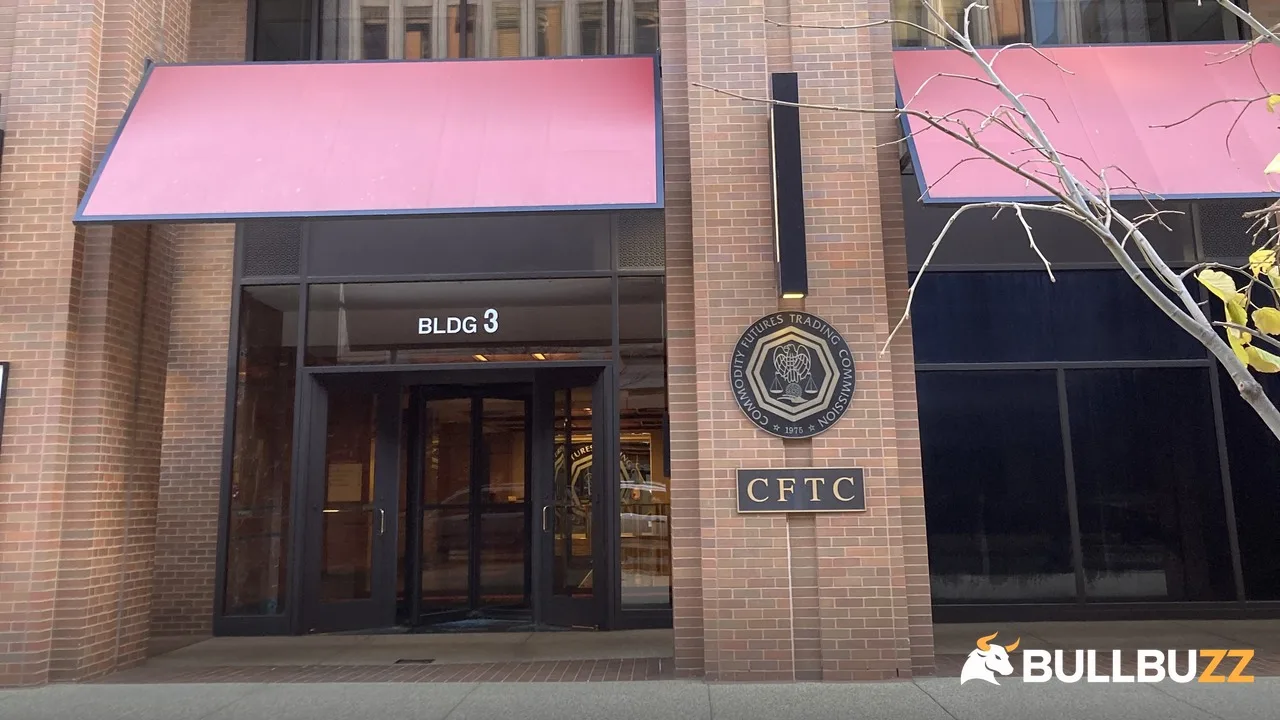
New CFTC Bitcoin reserves guidance lets US derivatives exchanges and clearinghouses count Bitcoin, Ether and payment stablecoins toward the financial reserves they must hold to cover a year of operating costs.
The advisory, CFTC Staff Letter 26-31, was issued on Monday by staff in the Commodity Futures Trading Commission’s Division of Market Oversight and Division of Clearing and Risk. It covers swap execution facilities, designated contract markets and derivatives clearing organisations. Until now, those firms could only count cash and traditional financial assets toward the requirement. The CFTC said certain crypto assets may now count as well, subject to valuation discounts known as haircuts.
It is the latest step in a year-long push to bring crypto inside the regulated US derivatives system. Bitcoin fell below $60,000 on Tuesday, giving back the whole of Monday’s rally, as US spot bitcoin exchange-traded funds recorded a fifth straight day of outflows.
How the CFTC Bitcoin reserves haircuts work
Under CFTC rules, the three types of venue must hold financial resources exceeding a full year of projected operating costs, calculated on a rolling basis. Staff said they would not object to Bitcoin and Ether counting toward that buffer after a minimum 20% haircut, and payment stablecoins after 2%. In practice, $100 of Bitcoin counts as $80 of reserve credit, and $100 of a qualifying payment stablecoin counts as $98.
Anything else is effectively excluded. A crypto asset that is not readily marketable and does not qualify as a payment stablecoin would generally take a 100% haircut, meaning it counts for nothing. Reuters reported that staff stressed the haircuts must reflect market and credit risk — and, for clearinghouses, liquidity risk as well.
Firms must also weigh what staff called wrong-way risk: the chance that crypto prices fall at the same time the firm itself is suffering business losses. Clearinghouses must build liquidity risk into their haircuts and review them every month. The guidance does not cover the default resources a clearinghouse holds against a member failure, which are governed by a separate rule.
Cash still rules the liquidity requirement
The more binding limit is unchanged: alongside the one-year buffer, each venue must hold part of it in unencumbered, liquid financial assets — cash or highly liquid securities. Swap execution facilities must hold at least three months of operating costs that way; designated contract markets and clearinghouses must hold at least six months.
Crypto cannot fill that slice at all. TradingView reported that crypto assets, including payment stablecoins, do not qualify as cash under generally accepted accounting principles or as highly liquid securities under the relevant rules. For an exchange or a clearinghouse, that means crypto can cover at most the other half of the year — and every dollar of Bitcoin in that half counts as no more than 80 cents.
Staff guidance, not a Commission rule
The letter is not a rule change. The CFTC was explicit that the advisory reflects the views of staff only: it creates no new rules or enforceable rights, it is not a no-action position, and it does not necessarily represent the views of the Commission itself. A formal Commission vote would be needed to make the staff position binding law.
Even so, the direction of travel is clear, and the agency’s chairman welcomed it. CFTC Chairman Mike Selig said he was pleased to see staff “continuing to provide important clarity on crypto assets in US derivatives markets through today’s staff advisory.” The letter defines a payment stablecoin, before the GENIUS Act takes effect, as certain US dollar stablecoins issued by a state-regulated money transmitter, trust company or national trust bank.
A year of crypto integration at the CFTC
The advisory builds on two earlier moves. The CFTC first allowed Bitcoin, Ether and USDC to serve as collateral for derivatives transactions in December 2025. Three months later, its staff introduced capital charges of 20% for Bitcoin and Ether and 2% for payment stablecoins held by brokers, in line with guidance from the Securities and Exchange Commission. InvestingLive reported that Staff Letter 26-31 extends the same framework from brokers’ positions to exchanges, swap venues and clearinghouses.
It also arrives as the market tests how far that integration can go. Bitcoin sank to a two-year low of about $55,254 over the weekend, rebounded briefly on Jensen Huang’s return as Nvidia chief executive, then handed the gains back. US spot bitcoin ETFs lost $569.7 million on Monday, taking November’s net outflows to about $4.71 billion, the largest for any month on record. Strategy, the largest corporate holder of Bitcoin, has slowed its buying sharply, adding just 457 coins in the week to 22 November.
What it means for traders
For venues that already hold crypto, those holdings can now earn reserve credit instead of sitting outside the calculation. For traders, the effect is narrower but real: regulated venues have one more reason to hold Bitcoin, Ether and stablecoins, and one more official acknowledgement that those assets belong inside the plumbing of US derivatives markets.
That progress runs against a difficult backdrop: the Federal Reserve is now fully expected to raise rates in December, a shift that has pushed the dollar to a near 20-month high. What to watch is whether the full Commission adopts the staff position, how clearinghouses set their monthly haircut reviews, and whether the GENIUS Act widens the definition of a qualifying payment stablecoin.