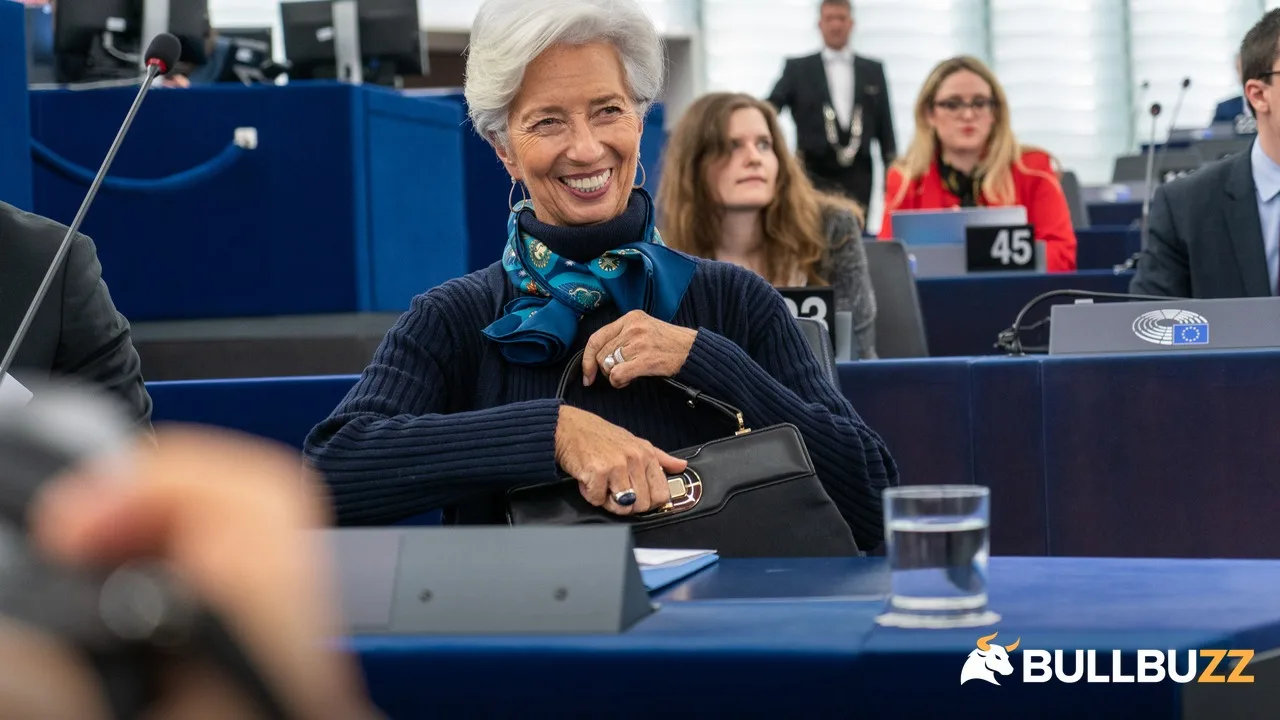
European Central Bank President Christine Lagarde has hinted at a December ECB rate hike, saying it would take a significant change in the data to alter the direction of travel as eurozone inflation holds at a three-year high of 4%.
Lagarde, in an interview with Japan's Yomiuri Shimbun published on Saturday, stopped short of committing to a move at the Governing Council's meeting on 17 December, but her language left little doubt about which way the bank is leaning. The euro rose on Monday, with EUR/USD trading around 1.1150 during Asian hours after two days of losses.
"We know that inflation numbers will remain high in the quarters to come," Lagarde told the newspaper, adding that the longer prices stay high, the greater the risk to the ECB's medium-term target. Investing.com reported, citing the interview, that she declined to commit to a December hike while making clear the bar for standing still is now high.
What Lagarde actually said about an ECB rate hike
Asked whether the ECB should raise rates before second-round effects — higher prices feeding into wages and back into prices — became visible, Lagarde said the Governing Council would keep deciding meeting by meeting on the basis of incoming data.
"So, I cannot tell you today that we will for sure do this in December," she said in the interview, which was conducted on Wednesday. "What I know is that, on the basis of the information we have today, it would take significant changes for the direction of travel to be different from what I expect. That's what I said during my press conference."
That framing echoes her message after the ECB's October meeting, when the bank held its deposit rate at 2.50% but Lagarde revealed policymakers had debated a hike before agreeing to wait for more data. Reuters reported that she repeated the point in Milan last week, saying the bank is watching incoming indicators to determine whether a hike is warranted next month.
Lagarde said the ECB has so far not seen second-round effects beyond those already built into its projections, and it is watching forward-looking indicators — including multi-year wage agreements and corporate wage expectations — without yet seeing evidence of a shift.
Why a December ECB rate hike is now the base case
The case for another increase rests on the inflation data. BullBuzz reported last week that eurozone consumer prices rose 4% year on year in October, up from 3.8% in September and the highest since September 2023, driven by energy costs, which climbed 20.8% from 18.9% in September. Core inflation held at 2.5% — still above the ECB's 2% target.
Lagarde is not alone in pointing toward December. Bundesbank President Joachim Nagel has said another hike may be needed in December if the inflation outlook does not improve, and the head of the Bank of Italy has also signalled a move next month is likely. Dow Jones reported, citing the Yomiuri interview, that Lagarde hinted at the possibility of a December increase.
Markets have taken the hint. Futures pricing implies roughly a 78% chance of a 25-basis-point increase in December, which would take the deposit rate to 2.75% — the third hike of the current cycle, after two increases this year. Goldman Sachs has maintained its December hike forecast and raised its projection for average eurozone inflation in 2027 to 3.3% from 2.7%, expecting a peak of 4.1% in the first quarter of next year.
The euro's reaction, and the Fed parallel
FXStreet reported that EUR/USD gained ground after two days of losses, trading around 1.1150 during Asian hours, supported by the ECB policymakers' comments and a softer US dollar.
The move is striking because the Federal Reserve is heading the same way. BullBuzz reported on Monday that hot US jobs data has pushed the odds of a Fed hike at its 9 December meeting to about 79%, after nonfarm payrolls rose 165,000 in October — more than double the 65,000 expected. The world's two biggest central banks are now both expected to tighten in the same month.
Traders get a fresh read on the US side on Tuesday, when October consumer price data is released at 9:30pm MYT. A hot reading would harden the case for the Fed to move; a soft one could revive doubts — and with them, the dollar's direction against the euro.
A decision that will outlast Lagarde
The December meeting will be among Lagarde's last in charge. She has announced she will step down on 7 February 2027, about nine months before her eight-year term formally ends. BullBuzz reported that the race to succeed her has narrowed to a two-way fight between Dutch central bank chief Klaas Knot and Spain's Pablo Hernández de Cos.
Whoever takes over will inherit a bank still fighting inflation it has not yet beaten, with staff projections due next month expected to show prices staying above target for longer. The Bank of England has already moved: BullBuzz reported last week that it raised its benchmark rate to 4% as UK inflation heads toward 5%.
For now, the market's reading is straightforward: the ECB expects to hike in December unless the data gives it a reason not to. Fresh inflation figures and the bank's own projections between now and 17 December will decide whether that expectation survives.