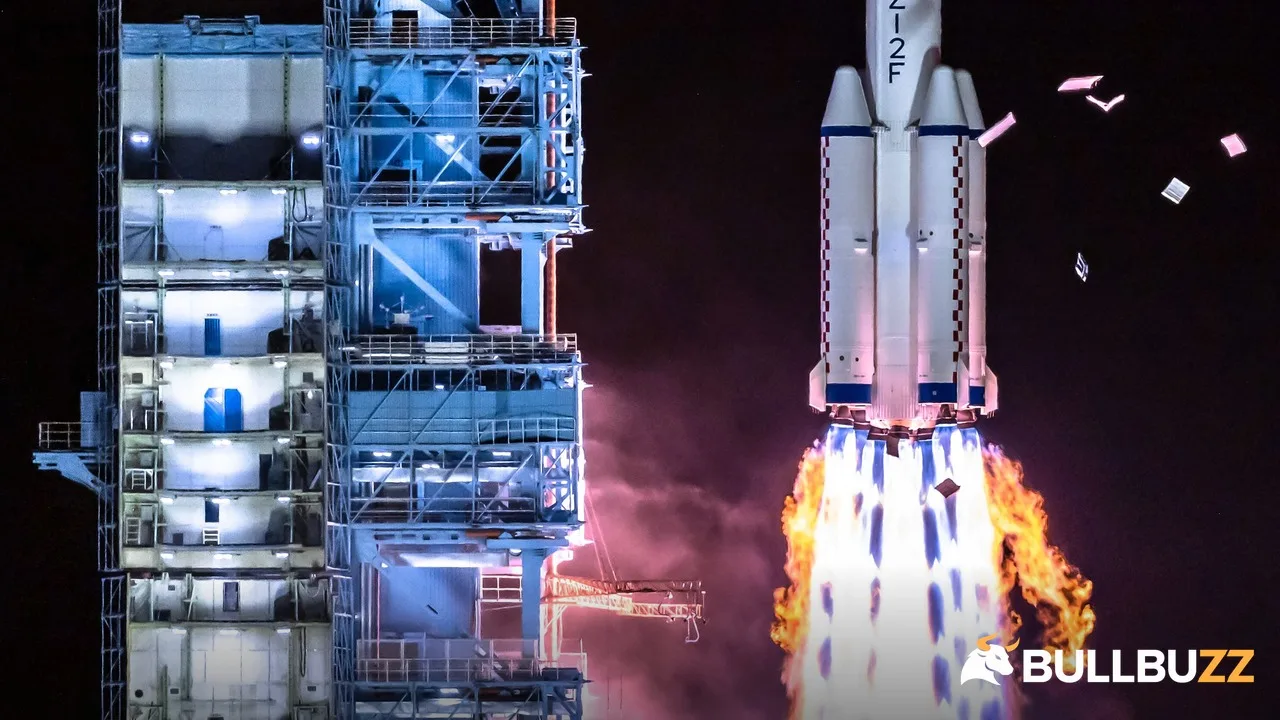
China's Shenzhou-24 spacecraft has carried Pakistan's first astronaut into orbit, in a landmark launch that puts the first foreign crew member aboard Beijing's Tiangong space station.
A Long March-2F rocket lifted off from the Jiuquan Satellite Launch Centre in northwest China at 8:18am MYT on Wednesday, carrying commander Tang Hongbo, flight engineer Wu Yi and Pakistani payload specialist Muhammad Zeeshan Ali. Reuters reported that the spacecraft separated from its carrier rocket about 10 minutes after blast-off and entered its preset orbit, and mission control declared the launch a complete success.
Ali, a 40-year-old former Pakistan Air Force fighter pilot, is the first Pakistani to reach orbit. He will become the first foreign national to board Tiangong when Shenzhou-24 docks with the station, about three and a half hours after launch. He is expected to spend about a week aboard the station conducting experiments before returning to Earth on the Shenzhou-23 spacecraft.
Shenzhou-24: Pakistan's First Astronaut Joins the Tiangong Crew
The mission is commanded by Tang Hongbo, who previously flew to Tiangong on Shenzhou-12 and Shenzhou-17, making him the first Chinese astronaut to visit the station three times. He is joined by first-time flyer Wu Yi as flight engineer, with Ali serving as payload specialist.
Ali's place on the crew was agreed under a cooperation deal signed in February 2025 between Pakistan's space agency, the Space and Upper Atmosphere Research Commission, and the China Manned Space Agency. Two Pakistani candidates, Ali and Khurram Daud, were chosen in April to train in China, and Ali was eventually selected for the flight. He trained for seven months in Beijing, including intensive Chinese-language classes, and told reporters on Tuesday he was deeply grateful to the Chinese government for helping Pakistan realise its dream of going to space.
"I'm not flying for myself. I carry the name of Pakistan on my shoulder," Ali said before the launch. "To every child who is watching while I am in orbit, just look up at the sky and remember that I am up there with your dreams."
Pakistan's planning minister Ahsan Iqbal, who watched the launch in China, said a new era had begun for Pakistan's space programme. "With him, the Pakistani flag rises into orbit, lifting the hopes and aspirations of 260 million Pakistanis for technological advancement and space exploration," he wrote.
Experiments Aboard Tiangong: Microalgae, Quinoa and 90 Studies
During the mission the crew will conduct around 90 experiments, according to the China Manned Space Agency, covering routine station operations and maintenance, an orbital handover with the outgoing Shenzhou-23 crew, and space science research. Dawn reported that Ali's own experiments include cultivating microalgae as a potential food and oxygen source for future space missions, and testing the effects of spaceflight on quinoa seeds.
Ali will return to Earth aboard Shenzhou-23 together with Zhang Zhiyuan and Hong Kong's first astronaut, Lai Ka-ying, who have spent the past six months on the station. The handover will be different this time: Shenzhou-23 commander Zhu Yangzhu will stay on to support Beijing's study of how the human body copes in space, and by the time he leaves he will hold the record for the longest single stay in orbit by a Chinese astronaut.
Tiangong, whose name means Celestial Palace, has been fully operational since late 2022 and can host up to six astronauts during crew handovers. For about a week, the station will be home to four astronauts from mainland China, one from Hong Kong and one from Pakistan.
Why Shenzhou-24 Matters Beyond the Launch
The flight is a milestone for China's space programme and for its push to present Tiangong as a hub for international cooperation, at a time when the NASA-led International Space Station faces possible retirement by 2030. Beijing has poured billions into its space programme as it aims to land astronauts on the Moon before 2030, a race in which the United States is also competing with its Artemis programme.
It also lands at a delicate moment in US-China relations, with technology at the centre of the rivalry. Only yesterday, a US jury convicted Huawei on 10 of 12 criminal counts in a case over its business in Iran and the theft of trade secrets, and Washington has moved this week to tighten technology export controls, blacklisting Megaspeed over the alleged diversion of Nvidia chips. Against that backdrop, Beijing is keen to show that its space programme is open to partners, and Islamabad has a vivid symbol of a relationship it calls higher than the skies.
For Pakistan, the flight is the country's entry into human space exploration, and Ali himself framed it as a beginning rather than an end. "This mission is not a finish line; it is a launch pad," he said. "And I hope the next chapter of China-Pakistan space cooperation will grow from one astronaut, one flight to multiple joint flights, to the Moon, Mars and beyond."