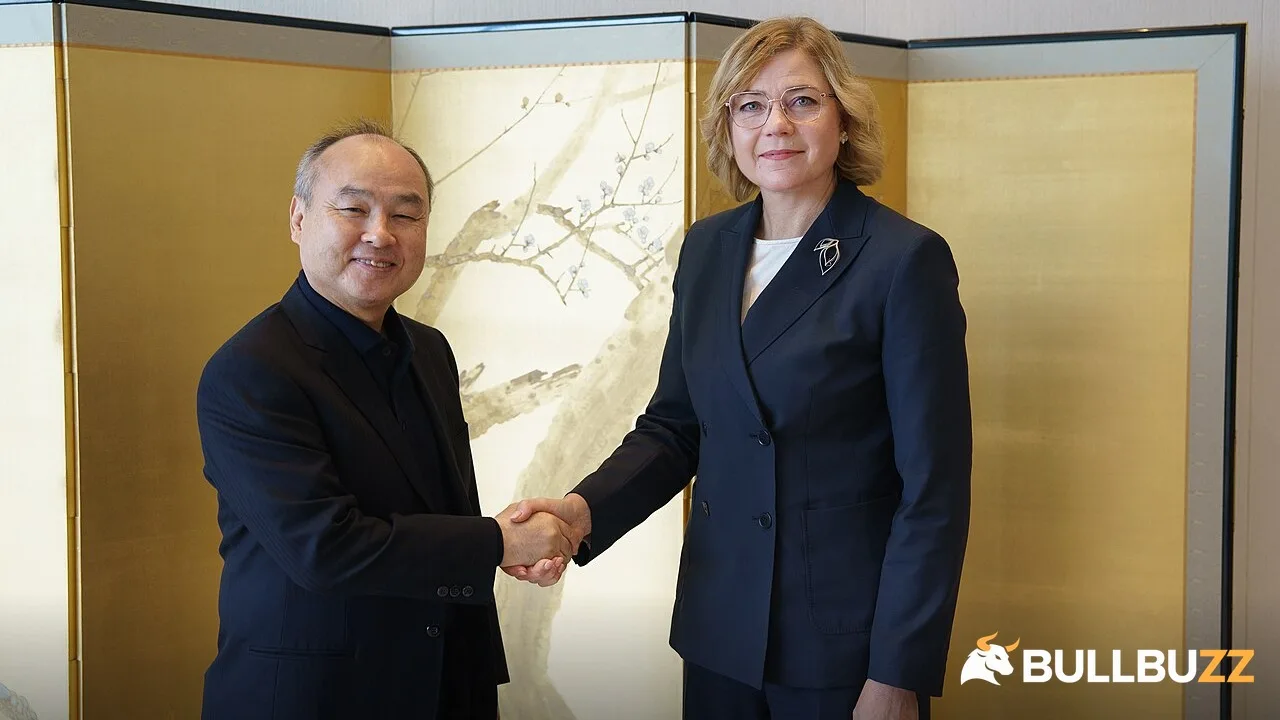
SoftBank Group founder Masayoshi Son recently sounded out Wall Street banks about financing a possible $1 trillion buyout of SK Hynix, The Information reported on Friday — a moonshot SoftBank SK Hynix deal for the world's second-largest memory chipmaker that SoftBank now says is no longer on the table.
Son approached major investment banks to discuss how to finance a purchase of SK Hynix, according to people familiar with the matter cited by The Information. The report emerged late on Friday in the United States — Saturday morning in Malaysia — and was quickly picked up by Reuters.
A SoftBank spokesperson told The Information that Son was no longer considering such a deal. "SoftBank looks at a wide range of opportunities, and this deal is no longer under active consideration," the spokesperson said. SoftBank and SK Hynix did not immediately respond to requests for comment from Reuters.
There was also no confirmation that Wall Street banks had discussed providing financing for a deal of that size, and it remains unclear how SoftBank would have funded it. The group has already stretched its balance sheet with its large commitments to OpenAI, and there is no indication banks were willing to extend the financing.
What a SoftBank SK Hynix deal would have bought
Memory is the one piece of the artificial intelligence supply chain SoftBank has yet to secure. SK Hynix is one of only three suppliers of high-bandwidth memory, or HBM, for AI accelerators, alongside Samsung Electronics and Micron Technology of the United States. AI accelerators pair logic chips with HBM to handle large-scale computation, and Nvidia effectively monopolises the market. The HBM boom has pushed profit margins at the three memory makers toward 80 percent.
SoftBank is already the largest shareholder in Arm, the chip design intellectual property company, and in SB Energy, which operates data centre and power businesses. It also owns Ampere Computing, a server chip designer, and DigitalBridge, a data centre investment firm, and has taken large stakes in Intel and OpenAI. An industry official told the Seoul Economic Daily that the approach, feasible or not, showed Son has a plan to take control of the entire AI value chain.
Son has relied on borrowing for each of his large investments. He financed the OpenAI stake by pledging Arm shares as collateral. Earlier, he borrowed against his Alibaba holding and ultimately sold the stake to help cover costs including the $32 billion purchase of Arm. In 2017, he pulled together money from the sovereign wealth funds of Saudi Arabia and the United Arab Emirates to launch the $100 billion Vision Fund, which invested in Uber, ByteDance and WeWork.
He has also been candid about missed chances in AI. Son recently described SoftBank's decision not to invest in Anthropic as a mistake — days before Anthropic's record stock market debut.
A $1 trillion price tag
The $1 trillion figure — about 1,400 trillion won — reflects SK Hynix's market value at its peak about a month earlier plus a 40 percent control premium, according to Seoul Economic Daily. The chipmaker is now worth about $577.7 billion, or 777 trillion won, after a sharp fall from that peak. A deal at $1 trillion would dwarf the largest takeover ever completed, several times over — and it was dropped at an early stage precisely because it was unlikely to be feasible.
Memory stocks caught in the AI rout
The report landed in the middle of a brutal week for AI stocks. Memory shares more than doubled in the first half of this year on the HBM boom, but have since entered a correction. On Friday, the S&P 500 fell 3.7 percent to enter correction territory as Nvidia plunged 14 percent, and markets across Asia slid with it — Taiwan's market, home to much of the AI hardware supply chain, has fallen sharply.
Strong results have not stopped the sell-off. Nvidia's earnings smashed forecasts only days earlier, with revenue doubling to $115.8 billion, yet the stock has still been swept up in the rout. For Son, the timing may explain the appeal: a memory champion suddenly cheaper than it was a month ago, at the centre of the technology he has bet SoftBank's future on.
For now, the deal is shelved. But the episode shows how far Son's ambitions in artificial intelligence extend — and how valuable memory, the unglamorous workhorse of the AI boom, has become. The question now is whether the idea stays shelved, or whether a cheaper SK Hynix brings it back.