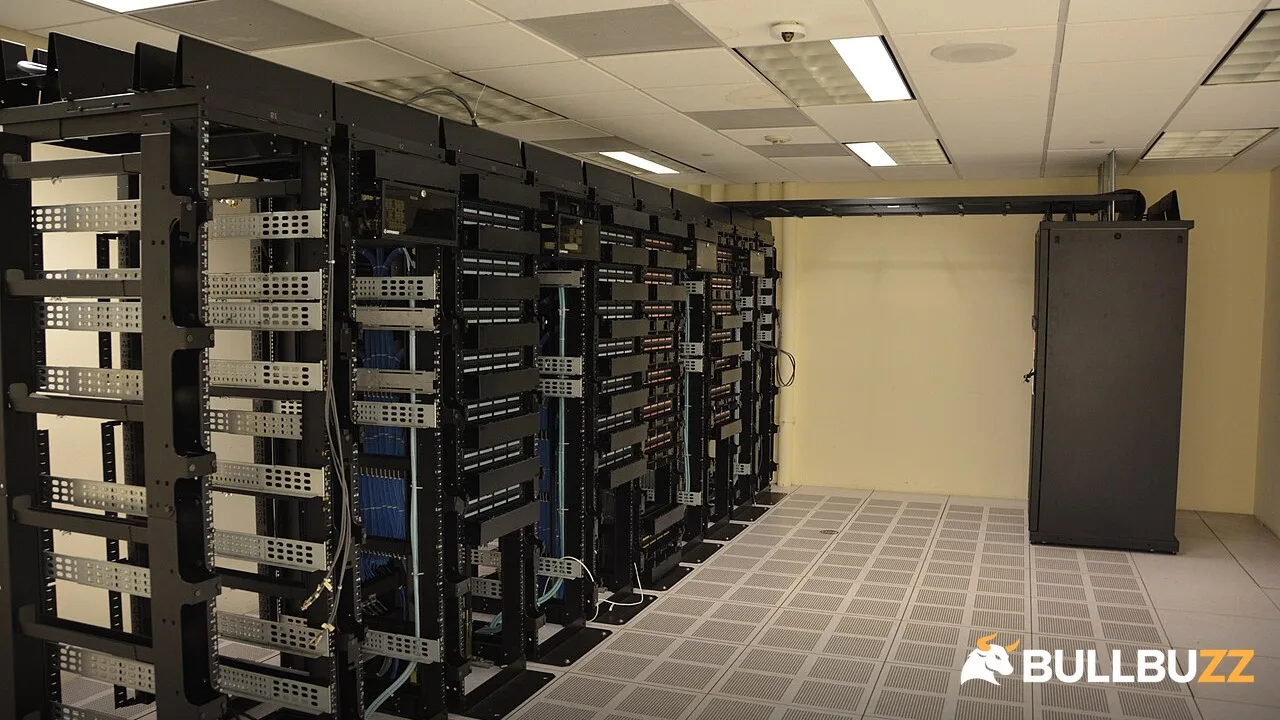
US President Donald Trump has threatened to impose a "tremendous tax" on American companies that build artificial intelligence data centres overseas, warning that China would seize the advantage if the facilities are built abroad.
"We're not going to allow our companies to build data centers outside of our country," Trump said at a White House news conference on Friday in Washington — early on Saturday in Malaysia — after returning from his trip to Asia. "If they do that, they can. But we're going to put a tremendous tax on them," Reuters reported.
"We're not allowing data centres to go into other countries because China will take all of them," Trump added, saying the United States would put "tremendous penalties" on companies that try. The warning came as the AI trade was reeling from one of its worst routs in years: the S&P 500 fell 3.7% on Friday to enter correction territory as Nvidia plunged 14%.
How would the Trump data centre tax work?
Trump gave no details on how the penalty would be enforced, and said he had not yet told his own officials about the plan, Al Jazeera reported. It is not clear what legal mechanism the administration could use to penalise companies for building facilities outside the United States, and no formal proposal has been published.
Data centres are critical to the AI boom because they provide the computing power needed to train and run increasingly complex AI systems, Reuters reported, and a penalty could complicate the global AI buildout. Developers often locate facilities close to users to cut delays for time-sensitive work, and moving large volumes of data over long distances adds cost.
Big Tech's overseas building plans in the firing line
Several major American data centre developers build and operate facilities outside the United States, including Equinix and Digital Realty. Amazon, Google, Microsoft and OpenAI are among the technology companies pledging billions of dollars to develop data centres overseas, seeking cheaper land, labour and electricity while avoiding the permitting battles that slow development at home.
Trump has repeatedly said the United States must win the race for what he calls "superintelligence" against China. "Whoever wins SI, wins," he said at the news conference, urging communities to welcome data centre construction and negotiate deals so the facilities "pay you".
The warning follows a tightening of US controls on the flow of AI computing power to China. On Monday, the Commerce Department moved to restrict exports of advanced AI chips to several Southeast Asian countries and to require a US licence before data centres anywhere in the world provide large volumes of computing power from advanced chips to companies headquartered in China. Trump also said he and Chinese President Xi Jinping had agreed to work on joint guardrails for AI.
The data centre boom is not confined to the United States. Malaysia's economy grew 5.5% in the third quarter, beating forecasts on the strength of its own data centre boom, as global demand for AI computing capacity spreads across Asia.
A wide-ranging news conference
The nearly 90-minute news conference ranged well beyond data centres. Trump defended his description of Russian President Vladimir Putin as a "friend" after the first-ever trilateral summit with Putin and Xi in Shenzhen, saying the three leaders had agreed to hold future talks on nuclear proliferation. He also accused Iran of negotiating in bad faith to end a war approaching its tenth month, and promoted a $17 billion investment plan for the Indo-Pacific region, the Sunday Guardian reported.
For now, the data centre threat is only that — a threat, made without a published plan, a timetable or a named enforcement mechanism. Whether it becomes policy will depend on what the White House puts on paper in the coming weeks, and on how the technology companies now building overseas respond. Markets in the United States are closed for the weekend; the first test of investor reaction will come when trading resumes.