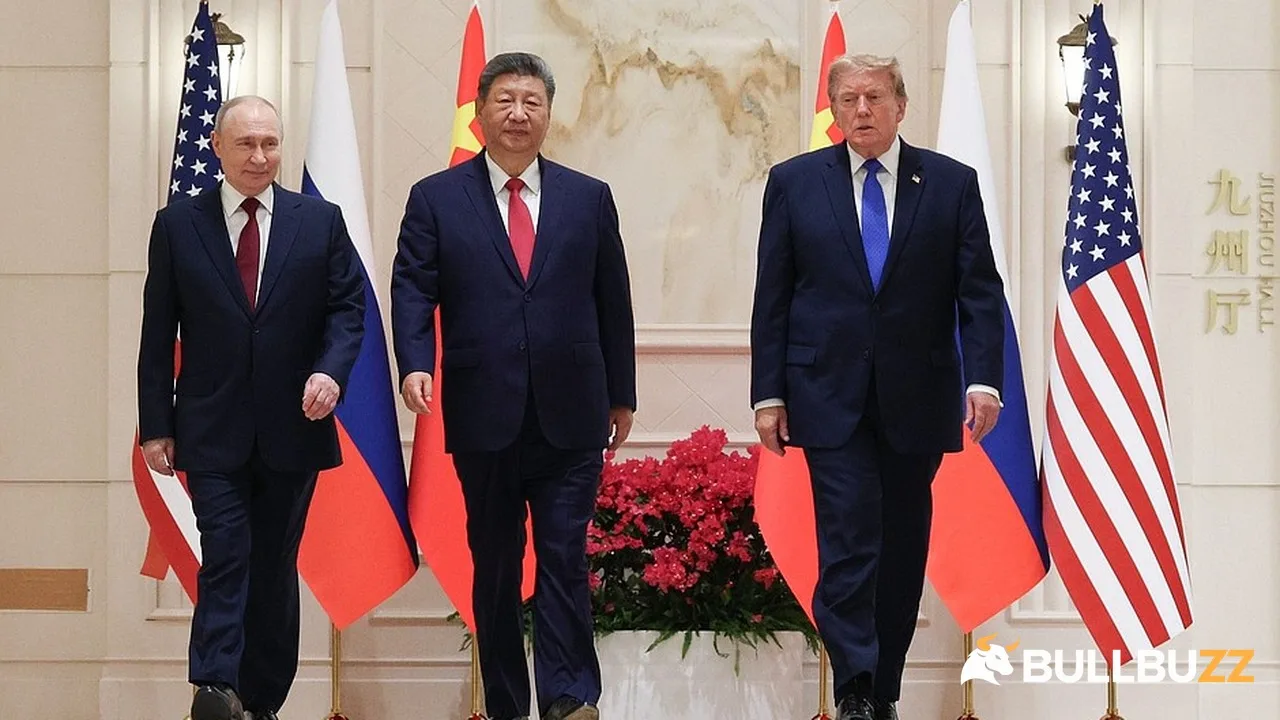
Donald Trump, Xi Jinping and Vladimir Putin signed the "Declaration Toward Peace" on Thursday evening, hours after their first-ever trilateral summit in Shenzhen ended with no agreement on nuclear arms, Ukraine or Iran.
The four-point declaration, titled "The Russia-China-US Heads of State Declaration Toward Peace", was adopted after the three leaders met for about 90 minutes at the Kylin Villa, a lakeside state guesthouse in Shenzhen, on the sidelines of the Asia-Pacific Economic Cooperation (APEC) summit. The Times of India reported the declaration was adopted on Thursday evening, and The National published the full text as released by Chinese state media.
The document is a statement of intent, not a treaty. It commits the three countries to reforming the United Nations, to increasing the production and supply of refined petroleum products, to defending the immunities of state officials, and to dialogue on reducing nuclear risks. It sets no timetable, no targets and no enforcement mechanism for any of the four points.
The four pledges in the Declaration Toward Peace
First, as permanent members of the United Nations Security Council, China, Russia and the United States committed to reform the UN so it can respond more effectively to global challenges and fulfil its mission of maintaining international peace and security.
Second, the three countries plan to increase the production and supply of refined petroleum products for the benefit of all nations, and reaffirmed the importance of stable energy flows. Bloomberg Law reported the energy pledge as the most concrete economic item in the declaration, though it contains no volumes, no timeline and no named mechanism for delivering the extra supply.
Third, the leaders recognised that state consent and respect for the immunities of state officials are of paramount importance, and agreed that the International Criminal Court and similar bodies must not abuse their jurisdiction — echoing Trump's remark that the court had "gotten out of control" and "strayed far beyond its jurisdiction".
Fourth, the three heads of state reaffirmed that a nuclear war cannot be won and must never be fought, and said the three countries will conduct a dialogue on reducing nuclear risks and preventing the proliferation of nuclear weapons.
A declaration, not a deal
The declaration does not change what the summit itself produced. When the meeting concluded at 6:01 p.m. MYT, there was no agreement on nuclear arms cuts, no agreement on Ukraine and no agreement on Iran, and no joint statement. BullBuzz reported at the close that the session had ended with no deal after about 90 minutes of talks, and the declaration published later in the evening does not reverse any of that.
It also makes no mention of Ukraine or Europe. The Kremlin's spokesman, Dmitry Peskov, said Ukraine was not the main topic. Trump and Putin had discussed Ukraine at length in a separate bilateral earlier on Thursday, where the Kremlin said it was the main topic.
The gap between the declaration's language and a binding agreement matters. The meeting took place nine months after New START, the last treaty capping American and Russian strategic arsenals, expired in February, leaving no binding limits on the world's two largest nuclear arsenals. China has long said it is neither fair nor realistic to ask it to join a replacement while its arsenal remains far smaller. A pledge to hold a dialogue is a first step since that treaty lapsed, but only a first step.
What the leaders said before the doors closed
The opening remarks, published in full by the Kremlin, set the tone the declaration later carried. Xi called the meeting "groundbreaking" and said a nuclear war "cannot be won and must never be fought". Trump said the three countries were "uniquely positioned" to discuss cutting nuclear weapons and called the meeting "making history". Putin said constructive cooperation between the three could strengthen global stability.
The session began at 4:16 p.m. MYT, about an hour late, after the three leaders posed for photographs on a stage carrying the words "China-Russia-US Shenzhen Summit". The Times reported that Putin left the venue at 6:23 p.m. MYT without speaking to media, and Trump boarded Air Force One and left China on Thursday evening.
Why the energy pledge matters for markets
For energy traders, the refined-products pledge is the part of the declaration with the most direct market read-across. It comes as oil prices slid on rising US crude stocks and surplus fears. A joint commitment from the world's largest oil producer, its largest importer and a major exporter to lift refined-product supply would, if acted on, lean against the tightness supporting fuel margins. But the declaration names no volumes, no grades and no start date, so traders have nothing concrete to price yet.
The declaration also lands against a tense backdrop. Beijing vowed countermeasures this week over new US curbs on advanced AI chips, and the summit was only confirmed days beforehand. That the three leaders still sat down together and produced a joint text is the real signal of the day, even if the text commits them to very little.
What matters now is follow-through. No date has been set for the nuclear-risk dialogue, and no further trilateral meeting has been announced. Until the three capitals name negotiators and a calendar, the Declaration Toward Peace will be judged as what it is: a first step by three rivals who have now, at least, agreed to keep talking.