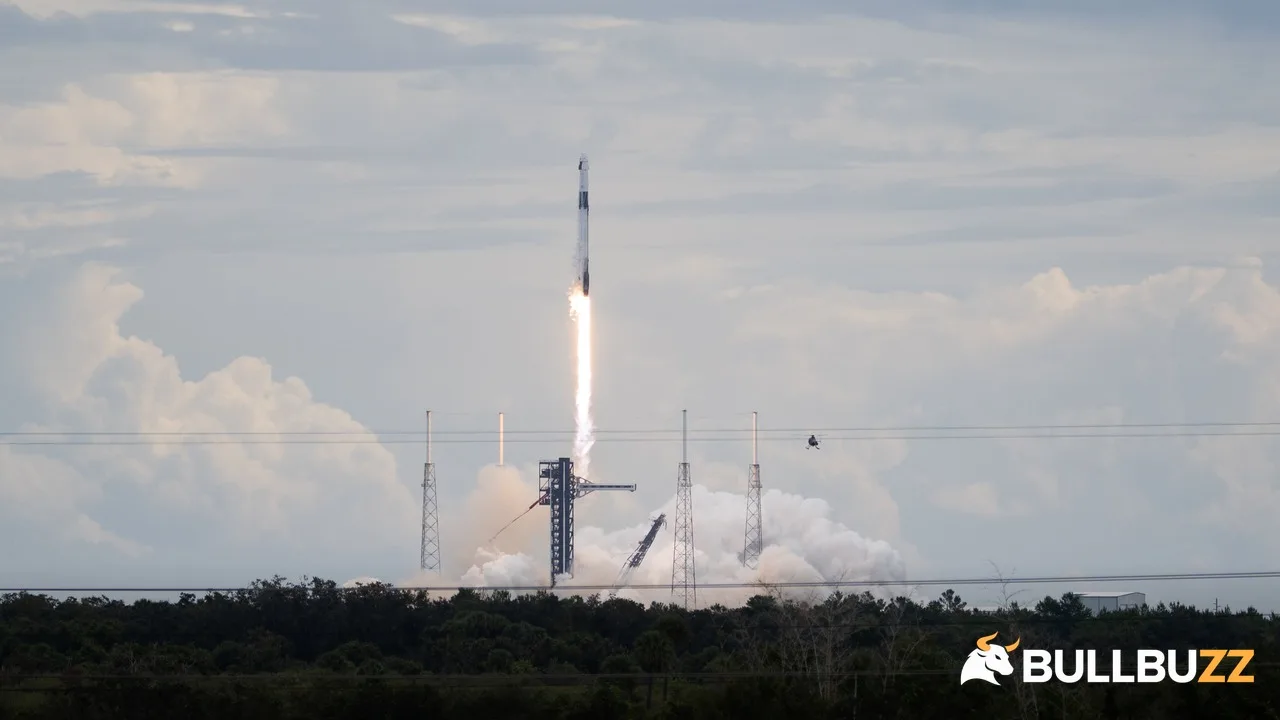
The US Federal Communications Commission has authorised Elon Musk's SpaceX to deploy up to one million satellites that will work as data centres in orbit, the first approval of its kind in American history — and a decision that lands just as traders pile back into the artificial intelligence trade.
The regulator said on Thursday it had cleared SpaceX's "Starmind" constellation, a network of orbital compute modules built to process vast amounts of data in space and send the results back to Earth, drawing its power from the sun. Reuters reported the FCC approved the plan to help meet rapidly growing demand for AI computing.
"America is leading the world into the era of super intelligence," FCC chairman Brendan Carr said in a statement, adding that the decision "opens a bold new frontier." Musk welcomed the ruling on social media, calling the network "a great asset to America and the world."
What SpaceX's Starmind constellation will do
SpaceX first put the plan to the FCC in January, seeking permission for up to one million satellites carrying AI chips. In August, the company said it was working with Nvidia to design the compute payload for the first Starmind satellite, with each satellite carrying Nvidia Rubin graphics processors and Vera central processors. GeekWire reported the satellites will operate in orbits between 500 and 1,002 kilometres above Earth.
The approval comes with strict deadlines. SpaceX must have its first Starmind satellite in operation by November 2033, reach 10 per cent of the constellation — 100,000 satellites — by November 2035, and half of it by November 2038, with the full network complete by 2040. The FCC also attached conditions covering communications backups, regular progress updates and a detailed plan for dealing with orbital debris.
The scale is hard to overstate. The network would increase the total number of satellites in Earth orbit by roughly 50-fold, and SpaceX is not alone: Blue Origin has proposed a 51,600-satellite constellation, Starcloud has applied for 88,000 satellites, and Google is testing its own orbital computing project, with its first satellites due to launch on Blue Origin's New Glenn rocket no earlier than 2029.
Objections over the night sky — and the physics
The FCC rejected opposition from Amazon's Kuiper Systems, the satellite operator Viasat and the American Astronomical Society, which had urged the regulator to refuse the application. The society said it was "disheartened and dismayed" by the decision, warning that the satellites would be larger and brighter than today's spacecraft and "visible as extremely bright objects for longer periods in the night sky."
The regulator said the constellation was consistent with its orbital debris rules and served the public interest, while noting that environmental questions raised by critics fell outside its authority. Arab News reported scientists also questioned whether the idea can work at all, with astrophysicist Adam Becker calling the prospect of a million data-centre satellites "a fantasy" and warning of the difficulty of shedding heat in the vacuum of space and the risk of cascading collisions.
Proponents argue the opposite: capturing the sun's energy in orbit would ease pressure on power grids on Earth and cut demand for sprawling computing warehouses and the water needed to cool them — the same pressures driving the data-centre boom that has dominated markets this year.
Why traders are watching the AI trade
The decision arrives in the middle of a violent week for AI stocks. Wall Street staged a late recovery on Wednesday after the Nasdaq 100 briefly touched bear-market territory, and Asian markets rebounded on Thursday, with South Korea's KOSPI rising and chipmakers Samsung and SK Hynix climbing sharply as Nasdaq 100 futures pushed more than 1 per cent higher, Swissinfo reported.
Nvidia sits at the centre of the story twice over: its chips will power the Starmind satellites, and its shares have driven the market's AI rally all year. Nvidia shares soared 31 per cent this week after Jensen Huang returned as chief executive, while the Bank of Korea raised rates on Thursday on the back of an AI-led export boom that has pushed South Korean growth forecasts sharply higher.
For now, Starmind exists only on paper: the first satellite is not due in orbit until the FCC's 2033 deadline, and SpaceX must still prove the hardware works at a scale nobody has attempted. Whether it can turn a million-satellite plan into working hardware — and whether astronomers, rivals and the laws of physics allow it — will decide whether Thursday's ruling becomes a turning point for computing, or a footnote in the AI boom.