Yemen's Houthi movement is trying to produce an advanced medium-range ballistic missile using purpose-built components linked to a Chinese supplier, according to a new weapons-tracing report. The Iranian-designed missile family cited in the findings can reach roughly 2,000 kilometres, extending the security implications across Saudi Arabia and toward Israel.
Conflict Armament Research, or CAR, said the evidence points to a larger domestic manufacturing effort than previously understood. The finding does not show that the Houthis have completed, tested or deployed the proposed missile.
What the Houthi Missile Report Found
CAR based its assessment on two shipments intercepted by authorities aligned with Yemen's internationally recognised government. Shipping documents showed that the containers had travelled from China and were intended for Hodeidah, the Red Sea port controlled by the Houthis.
Investigators identified parts associated with the airframe and solid-propellant motor of Iran's Khaibarshekan missile family. The seized cargo included:
- Stabilising-fin cores shaped for a missile airframe.
- Rocket-motor aft closures and nozzle attachments.
- Rocket-motor igniters and specialised raw materials.
- Phenolic resin, which can be used in heat-resistant missile structures.
The Associated Press reported that Fabian Hinz, a senior CAR analyst, described the components as highly specific. Their design would have required information related to the missile, he said.
Why the 2,000km Range Matters
The Khaibarshekan is an Iranian precision-guided ballistic missile with a range of roughly 1,200 miles, or 2,000 kilometres, according to AP. A successful Houthi-produced version would represent a step beyond assembling shorter-range rockets and drones from imported components.
That range figure belongs to the Iranian missile family. It is not proof that a Houthi-built version has achieved the same performance. CAR's primary finding is that the group is attempting to manufacture at least part of the system.
The report arrives after a week of attacks on Saudi infrastructure. BullBuzz has covered the latest Riyadh missile interception and the strike on a Saudi Aramco administrative building in Dhahran. Those incidents have increased scrutiny of the kingdom's ability to protect airports, cities and energy assets from repeated launches.
What the Chinese Supplier Link Proves
The documents cited by CAR listed a Chinese supplier, and the shipments originated from China. The evidence does not establish that China's government approved, directed or knew about the transfers.
A Chinese Embassy spokesperson told AP that Beijing follows a prudent approach to military exports and strictly controls dual-use items. The spokesperson did not address CAR's specific findings.
The distinction matters because the Houthis remain under a targeted United Nations Security Council arms embargo. Investigators are tracing commercial suppliers and intermediaries, while governments will need to determine whether export-control or sanctions rules were breached.
Iran Still Sits at the Centre of the Design
The suspected manufacturing plan is based on an Iranian missile design, and the Houthis have long relied on Iran-linked supply networks. CAR said the latest discovery shows the group is also seeking specialised components beyond those established channels.
Yemen experts cited by AP said the Houthis may still depend on Iran for harder-to-produce navigation and control systems. Imported metal parts and motor components would therefore increase local assembly capacity without proving full independence from Tehran.
The shift toward parts rather than complete weapons also complicates interdiction. Saudi officials are already investigating gaps exposed by the recent airport attacks and warning failures.
Why the Missile Supply Chain Matters for Markets
Missile development is a security story with direct economic exposure. Saudi Arabia is the world's largest crude exporter, while the Red Sea and Bab el-Mandeb form a key route for energy and container traffic. Repeated attacks can affect insurance costs, flight schedules and expectations for oil supply even when production remains intact.
Markets have already been trading around those risks. BullBuzz's Asian markets and oil report tracked how the Saudi conflict and crude prices were feeding into regional equities.
What Investigators Will Watch Next
The next evidence will come from fresh seizures, component tracing and any missile tests or deployments that reveal the system's actual performance. Investigators will also look for guidance electronics, production tooling and links between suppliers, freight companies and buyers.
For Saudi Arabia, the immediate question is whether air defences can adapt faster than the Houthi arsenal. For China and other manufacturing hubs, the pressure will fall on export screening and enforcement against intermediaries serving sanctioned weapons programmes.
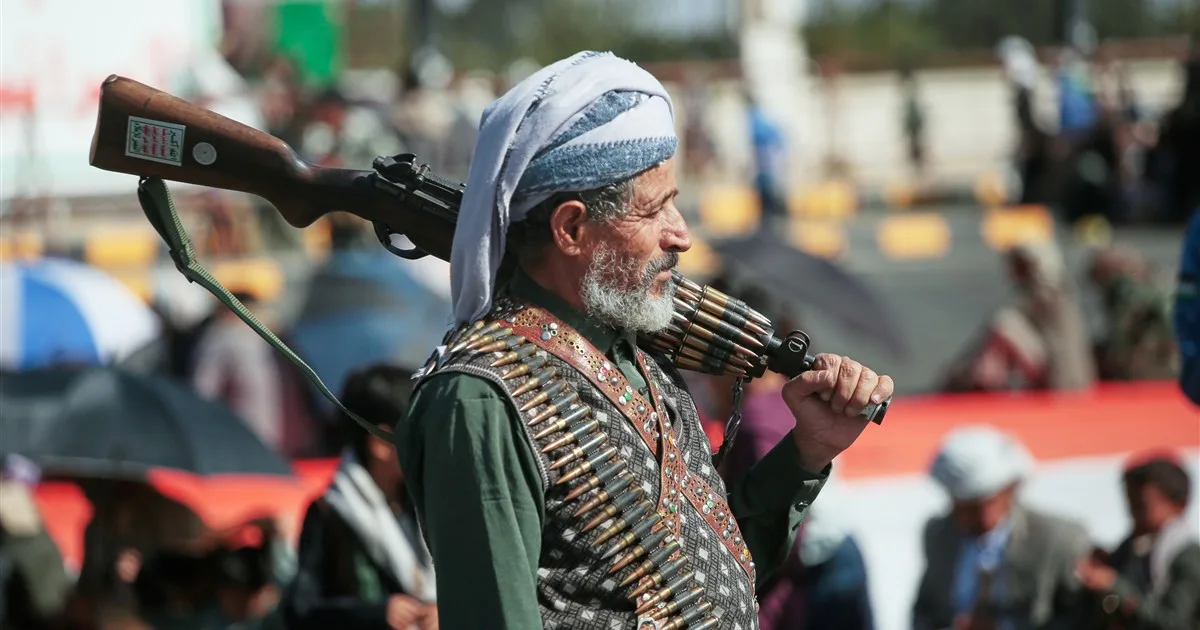
Banner: A Houthi supporter at a rally in Sanaa, Yemen, on 9 October 2026. The photograph illustrates the armed movement and does not show the seized missile components. Photo: Osamah Abdulrahman/AP.