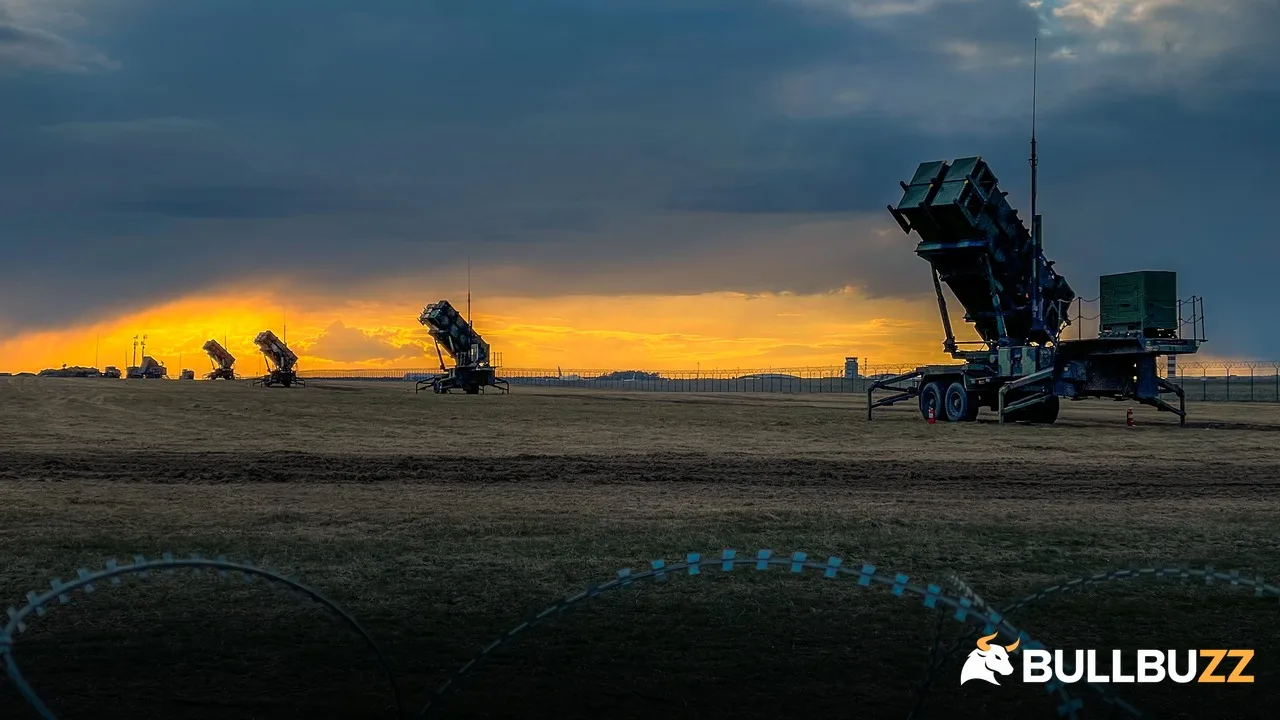
Iran's Revolutionary Guard says its forces struck two US Patriot air-defence radars at bases in Bahrain late on Saturday, in the latest Iranian attack on the Gulf kingdom, while Bahrain said a civilian industrial facility caught fire and two people were injured.
The Islamic Revolutionary Guard Corps (IRGC) said its aerospace force hit US military positions at the al-Riffa and Awali bases with a combined missile and drone operation, Xinhua reported, citing a statement carried by Iranian state broadcaster IRIB. "Two radars belonging to the US Army's Patriot air defence systems ... were struck," the statement said.
The Guards said the operation was retaliation for what it called continued violations of Iranian airspace by US MQ-1 and MQ-9 drones, and for an attack on a radar installation on Iran's Hengam Island.
Iran attacks Bahrain: what each side says
Bahrain's account differs sharply from Tehran's. The kingdom's Interior Ministry said an Iranian attack caused a fire at a civilian industrial facility, reporting material damage but no injuries at first, and did not name the facility or say where it was, Al Jazeera reported. Air-raid sirens sounded before the ministry issued an all-clear, and Bahrain's Defence Force said its air defences intercepted several Iranian aerial attacks late on Saturday.
On Sunday, the ministry said two people had been hurt: a Bahraini citizen with disabilities was in stable condition, while a Pakistani resident was in critical condition, Dawn reported. Residents reported smoke over Sitra Island, which hosts industrial sites including facilities run by state oil company Bapco, though officials have not confirmed the location of the fire.
Washington has not confirmed the radar claim. A US official told CBS News the attacks caused no damage to US military personnel or facilities in the region, The Defense News reported. Iran's own reporting was inconsistent: the semi-official Fars news agency said the strikes targeted the Shaikh Isa and Al Juffair bases, not the al-Riffa and Awali bases named in the IRGC statement.
Bahrain urges UN action as Gulf allies condemn the attack
Bahrain's Foreign Ministry condemned the strikes "in the strongest terms" and called on the United Nations Security Council to take "firm measures to compel Iran" to implement Resolution 2817, adopted in March, which condemned Iranian attacks on Gulf states and Jordan and demanded an immediate halt to hostilities and maritime interference.
The Gulf Cooperation Council's secretary-general, Jassim Mohamed AlBudaiwi, expressed "full solidarity" with Bahrain, saying the kingdom's security and territorial integrity are integral to the security of all Gulf states. Jordan condemned the strike as a "flagrant violation" of Bahrain's sovereignty and a serious threat to regional security.
Oil markets shrug as Hormuz shipping stays in focus
The attack came as the US-Israel war on Iran, which began in late February, grinds on around the Strait of Hormuz, the shipping lane through which about a fifth of the world's oil passed before the war. Bahrain hosts the US Navy's Fifth Fleet and has been attacked repeatedly since the war began, including three drone attacks in recent days after a lull of several weeks. Multiple tankers have also been struck in the strait in recent days, and Iran has kept up efforts to blockade the waterway while the US military escorts ships through it and maintains its own counterblockade of Iranian ports.
Oil traders largely shrugged off the Bahrain strikes. Brent crude slipped on Monday's open despite the attacks, with the market focused on ample supply rather than the Gulf fighting. BullBuzz reported that Houthi strikes and tanker blasts in the strait had already pushed prices higher, but the surplus narrative has kept a lid on the rally.
Iran's Foreign Minister Abbas Araghchi said on Saturday that "the ongoing talks in the region must be given a chance, and the blockade must be lifted rationally", while adding that as long as Iran's demands are not met, discussion of reopening the strait is "pointless". Tehran's demands include ending the war on all fronts, unfreezing Iranian assets, lifting oil sanctions and ending the US counterblockade of its ports.
What happens next
The focus now turns to Washington's response, to whether the Security Council takes up Bahrain's call, and to whether the regional talks Araghchi pointed to can make progress before the next strike. The Bahrain attack follows a pattern of Iranian strikes on Gulf states that has widened through the autumn, including last week's tanker attacks in the Strait of Hormuz and the US shooting down Iranian drones heading for Bahrain, and it comes days after a Russian missile crashed in Poland, a reminder that air-defence systems are being tested on two fronts at once.
For markets, the test is whether the fighting stays away from oil infrastructure. So far it has: no supply has been cut, and traders have treated each strike as a headline rather than a disruption. That calm holds only while the strikes keep missing the barrels.