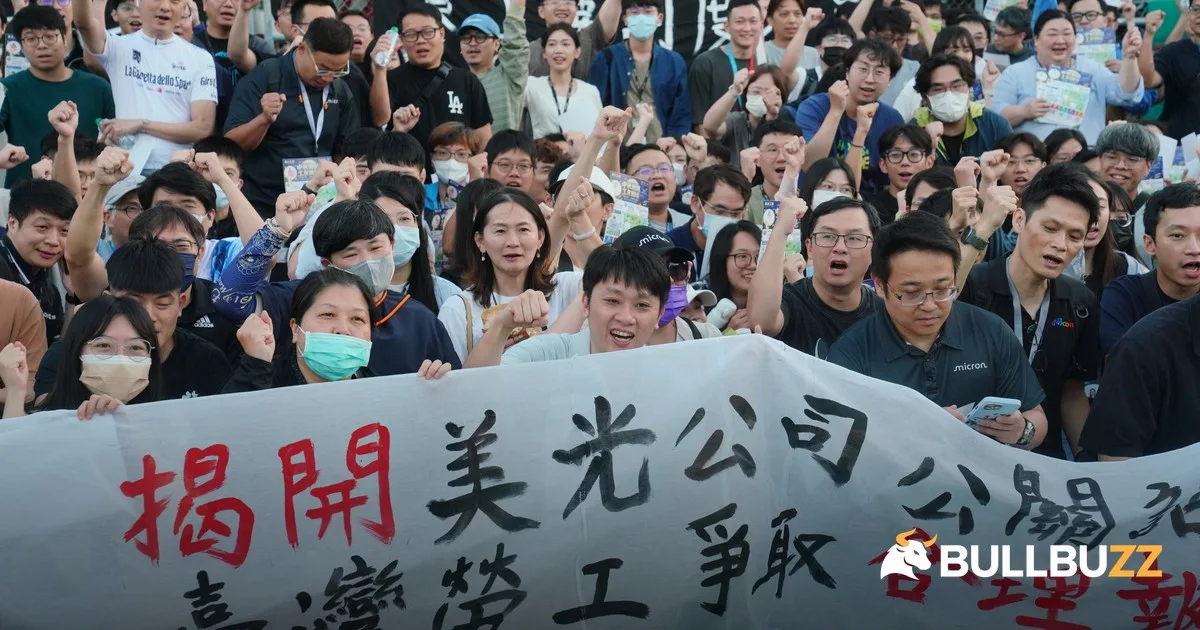
Micron Technology workers in Taoyuan, Taiwan, will begin a strike on Thursday, 22 October, escalating a dispute over bonuses and long-term profit sharing at one of the chipmaker's most important Asian manufacturing hubs.
The Taoyuan union said the walkout will coincide with a mediation meeting between Micron and a separate union representing workers at its larger Taichung operation. The Reuters report said the union has not disclosed how long the strike will last and plans to release further details on Thursday.
The immediate market issue is operational risk. Taiwan produces a large share of Micron's DRAM and high-bandwidth memory, or HBM, used in AI servers. A walkout does not automatically mean output will stop, but it introduces another uncertainty for a memory market already shaped by rapid AI demand and tight supply.
Why Micron's Taiwan Union Is Striking
The dispute centres on how Micron shares its earnings with employees. The Taoyuan union wants a permanent formula that distributes 15% of operating profit through employee bonuses. Micron announced a large fiscal 2026 rewards package in September, but the union said a one-time payment did not answer its demand for a transparent, recurring system.
Workers secured legal authority to strike earlier this month. Focus Taiwan reported that 1,994 members backed industrial action, equal to 99% of ballots cast and 88.3% of all eligible members. Taiwan's labor-dispute law requires approval from more than half of a union's total membership before a strike can be called.
The Taoyuan union said Thursday's action is also intended to support the Taichung union during mediation and pressure Micron to present a concrete proposal. Taichung's union has not held its own strike vote. The two groups are legally separate and are at different stages of the dispute.
- Strike date: Thursday, 22 October 2026.
- Site involved: Micron's Taoyuan operation in Taiwan.
- Main demand: a permanent profit-sharing system linked to operating profit.
- Unknown: the strike's duration and any confirmed production impact.
Why DRAM and HBM Supply Matters
Micron employs about 15,000 people in Taiwan and has said it invested more than NT$1.6 trillion, or roughly US$49 billion, on the island. The company is expanding advanced DRAM and HBM capacity to serve AI infrastructure demand. Its 2026 sustainability report describes Taiwan as a centre for modernising DRAM and HBM production.
HBM sits beside processors in AI accelerators, while DRAM supports servers, personal computers and other electronics. Supply interruptions can affect contract negotiations and customer inventories, yet the scale depends on which workers participate, how long the action lasts and whether Micron can keep essential lines operating.
BullBuzz previously reported Micron's record fiscal-year results, which form part of the backdrop to employee demands. The dispute also lands after TSMC's sharp profit increase and amid renewed pressure on Asian chip shares, including the recent Samsung and SK Hynix-led KOSPI selloff.
What the Strike Could Mean for Investors
The announcement is a labour-development risk, not proof of a supply shock. Reuters said the Taoyuan union represents only one of Micron's Taiwan operations, while the larger Taichung group remains in mediation. Micron has previously said it respects employees' legal rights and will continue using established dialogue and mediation channels.
Investors should watch three signals on Thursday: the number of workers who join the strike, Micron's statement on factory operations and the result of the Taichung mediation. Any evidence of delayed output or shipments would matter more to memory pricing than the announcement alone.
The dispute also tests how the AI boom's profits are shared across Asia's semiconductor workforce. Micron's official newsroom shows a record-results year and continuing investment in new memory technology. Employees are arguing that compensation rules should move with those economics rather than rely on exceptional one-off awards.
What Happens Next
The Taoyuan union is expected to disclose the strike's scope on 22 October. On the same day, the Taichung union and Micron are scheduled to resume mediation. A settlement could limit disruption; failed talks could broaden labour pressure. Until those outcomes are known, claims about a major HBM shortage or customer delays would be premature.
This report is for information only and does not constitute investment advice.
Photo: Micron workers at a Taoyuan union gathering in September 2026. Yang Hong-hsi / Mirror Media.