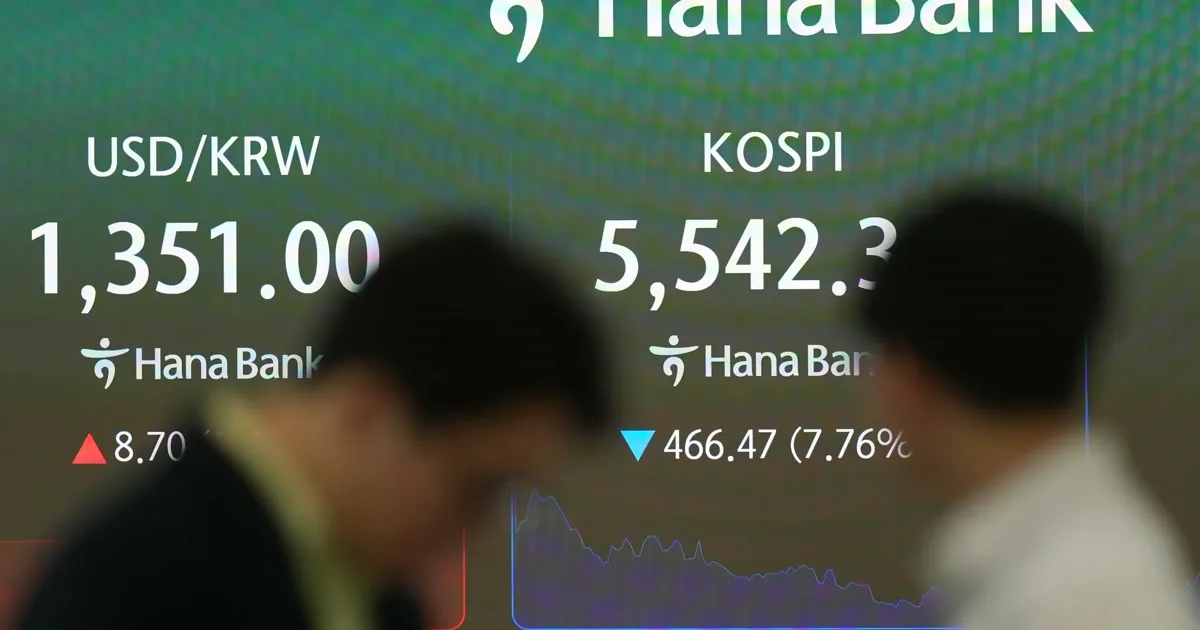
South Korea's KOSPI plunged 7.57% to 5,554.22 on Thursday as a global technology sell-off hit Samsung Electronics and SK Hynix, forcing the Korea Exchange to halt trading for 20 minutes.
The benchmark lost 454.59 points and closed at its lowest level since April 7, according to Yonhap News Agency. The index had fallen as much as 9.29% before recovering part of the decline.
The fall extends a sharp reversal in AI-linked shares. BullBuzz's report on US inflation reaching 3.7% showed why investors raised their rate expectations, while TSMC's record quarterly profit showed that chip demand remains strong even as valuations come under pressure.
KOSPI Drop Triggers a Circuit Breaker
The Korea Exchange stopped trading on the main board for 20 minutes at 12:38 p.m. Seoul time after the KOSPI remained more than 8% below the previous close for one minute. Its official circuit-breaker rules use declines of 8%, 15% and 20% as escalating thresholds.
A separate sell-side sidecar had already suspended program selling for five minutes after KOSPI 200 futures fell more than 5%. The measures paused order flow, but they did not reverse the wider selling pressure.
Declining shares outnumbered advancers by 787 to 112. Foreign investors sold a net 3.62 trillion won of shares, while domestic institutions and individuals were net buyers, Yonhap reported.
Samsung and SK Hynix Lead the Chip Rout
Samsung Electronics fell 9.48% to 210,000 won. SK Hynix dropped 11.06% to 1.26 million won, making the two chipmakers the main weights on a market heavily exposed to artificial-intelligence spending.
The selling spread across the regional technology chain. Associated Press reported that Japan's Nikkei 225 lost 4.9%, Taiwan's Taiex fell 3.4%, and Hong Kong's Hang Seng declined 1%. SoftBank Group, Tokyo Electron and Kioxia also posted steep losses.
Chip earnings have not collapsed. TSMC reported a 68.7% increase in quarterly profit on Thursday, and its 2-nanometer production ramp accelerated. The market is instead testing whether the revenue generated by AI infrastructure can justify the capital spending and stock valuations built into the sector.
Hot US Inflation Raises the Discount-Rate Risk
The sell-off followed a weak Wall Street session after US consumer prices rose faster than expected. The US Bureau of Labor Statistics said the consumer price index increased 0.6% in September and 3.7% from a year earlier. Core inflation was 2.6%.
Higher inflation can keep interest rates elevated or revive rate-increase expectations. That matters most for companies whose share prices depend on profits projected far into the future, including many AI and semiconductor names.
The US 10-year Treasury yield eased to about 5.09% on Thursday after briefly moving above 5.32% a day earlier, AP reported. Even after that retreat, borrowing costs remain high enough to pressure richly valued technology shares.
Why the KOSPI Sell-Off Matters Across Asia
The KOSPI has now fallen for seven consecutive sessions, its longest losing streak since September 2024. Thursday's close left the index more than 16% below its level one month earlier.
The move matters outside South Korea because Samsung and SK Hynix supply memory used in data centres, phones and AI systems. Their share prices act as a barometer for expectations across the regional chip chain, including equipment makers and manufacturers tied to Malaysia's expanding digital infrastructure.
BullBuzz's coverage of ASML's long-range order discussions and Malaysia's data-centre grid costs shows the two sides of the same buildout: strong demand for advanced computing, paired with rising capital and financing demands.
What Investors Should Watch Next
- Friday's KOSPI open: whether the index stabilises after the circuit breaker or foreign selling continues.
- Samsung and SK Hynix: whether chip shares find support after losses of 9.48% and 11.06%.
- US bond yields: whether the 10-year yield resumes its rise as traders reassess Federal Reserve policy.
- AI earnings: whether results and spending plans support the growth assumptions behind semiconductor valuations.
The next session will show whether Thursday's plunge was a forced reset after a crowded AI trade or the start of a deeper repricing across Asia's chip-heavy markets.
Image note: Dealers stand beside KOSPI and won exchange-rate screens at Hana Bank in Seoul on October 15, 2026. This photograph was taken during the market sell-off covered in this report. Photo by Lee Jin-man/AP.