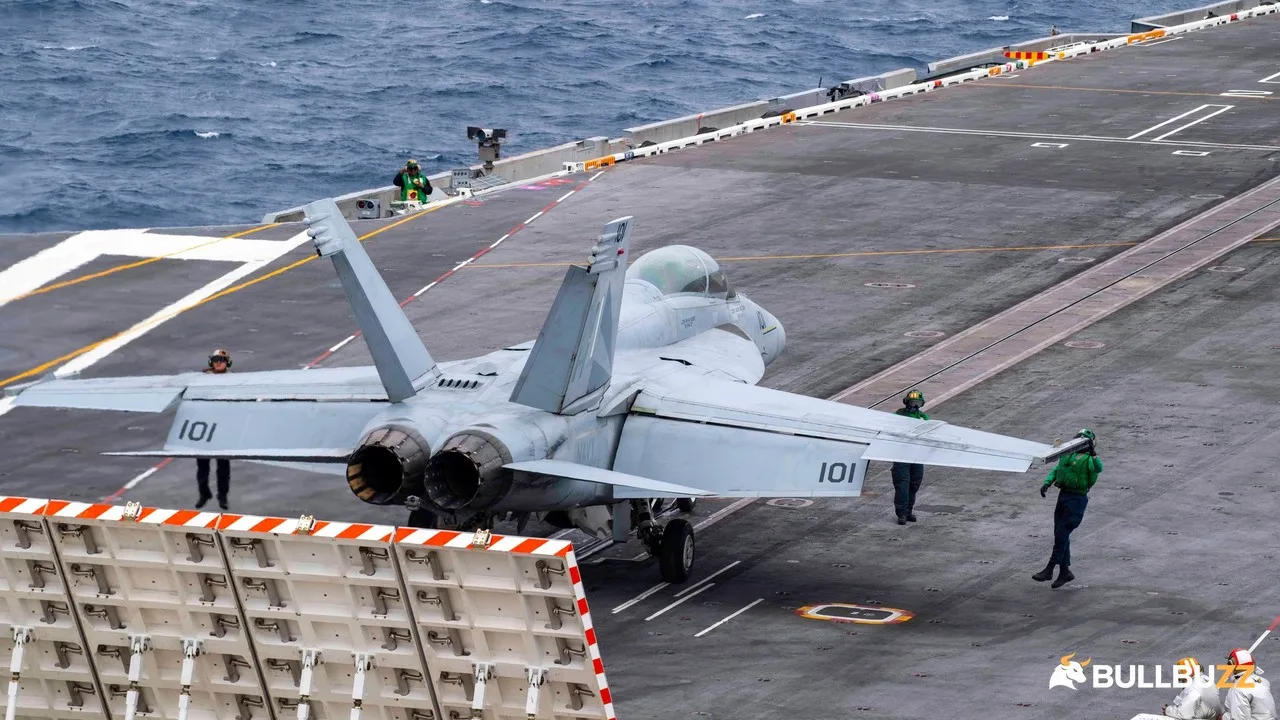
US fighter jets struck an Iranian Revolutionary Guard missile launch site on Qeshm Island in the Strait of Hormuz on Tuesday, in the sharpest exchange of fire between the United States and Iran since the war triggered by US-Israeli strikes in late February, as Gulf states intercepted further Iranian attacks early on Wednesday.
The strike was retaliation for an Iranian drone attack on a US military radar system in Bahrain hours earlier, a US military official told Reuters, describing the operation as self-defence against Iranian aggression targeting US personnel and assets. US aircraft used precision munitions to hit the Islamic Revolutionary Guard Corps (IRGC) missile launch site on Qeshm Island, the official said, speaking on condition of anonymity.
Iran's official IRNA news agency cited a regional official as saying the US had hit the island without causing serious damage. Provincial official Ahmad Nafisi said the attack caused no damage to residential or commercial areas or vital infrastructure, although Iranian media reported that an air-defence missile launcher in the island's Nariman area was targeted, and the IRGC-affiliated Tasnim agency said several projectiles struck the island.
Earlier on Tuesday, the Revolutionary Guards said their combat drones had carried out a precision operation against a radar system operated by US forces at Sheikh Isa Air Base in Bahrain, in response to what Tehran called repeated violations of Iranian airspace by US military drones. US Central Command said the Iranian drones were intercepted, with no damage to US equipment and no injuries to American personnel. The Guards also said they had intercepted and captured a US drone south of Qeshm.
US strikes Iran: Bahrain and Kuwait intercept new attacks
The exchange did not stop overnight. Bahrain's armed forces said on Wednesday that they had confronted, intercepted and destroyed a number of Iranian aerial attacks before they could achieve their objectives, and the Bahrain Defence Force said its air defences countered a new wave of Iranian strikes early in the morning. Bahrain, which hosts the headquarters of the US Navy's Fifth Fleet, said it intercepted the attack, with no reports of casualties or damage.
Kuwait said on Wednesday that its air defences were responding to hostile drone attacks, as Washington's Gulf allies remained on high alert hours after the US struck Qeshm Island. The renewed fighting has put the region's air defences on edge even though the war that began with US-Israeli strikes on Iran in late February had settled into a lull in recent weeks. The Strait of Hormuz, where Qeshm Island sits, is the conduit for a large share of global energy shipments, and any threat to shipping through it reaches oil markets within hours.
The same waterway has already seen attacks on commercial shipping during this conflict. Tankers transiting the Strait of Hormuz were hit by mines earlier in the war, while US forces shot down Iranian drones threatening vessels in the channel.
Oil steadies as Hormuz risk offsets rising US stockpiles
Oil prices fell on Wednesday, but only modestly, as higher US crude inventories tempered the supply risk from the fighting. Brent crude futures were trading down 16 cents, or 0.17%, at $92.98 a barrel, while US West Texas Intermediate futures fell 56 cents, or 0.65%, to $85.45 a barrel, Reuters reported.
US crude stocks rose by 5.28 million barrels in the week ended 13 November, market sources said, citing data from the American Petroleum Institute, while gasoline stocks rose by 5.12 million barrels and distillate inventories by 351,000 barrels. But continued tensions between the US and Iran and ongoing risks to shipping through the Strait of Hormuz kept price declines limited. The oil market had already flipped to surplus before this week's escalation, with the International Energy Agency expecting Gulf exports to outpace demand.
Third US carrier joins the Gulf buildup
The strikes came as the US deployed the aircraft carrier USS Theodore Roosevelt to the region, raising the number of American carrier strike groups there to three, AFP reported. The buildup has been under way for weeks as Washington reinforced its forces around the Gulf, and the arrival of a third carrier gives US commanders a far larger pool of strike aircraft within range of Iran.
The exchange also came days after US intelligence flagged an alleged Iranian plot involving a radioactive "dirty bomb" in Washington, an allegation Tehran denies. Despite the firing, diplomacy has not stopped: Iran remains in talks with mediators Oman and Qatar, which have been shuttling between the two sides to prevent the standoff from sliding back into full-scale war.
What to watch next
US stocks fell for a second straight day on Tuesday, with the Dow Jones Industrial Average down 1.64% and the S&P 500 down 1.03%, as the escalation added to pressure from a sell-off in AI-linked shares. Asian tech stocks had already plunged ahead of Nvidia's earnings, and traders are now watching whether the Gulf fighting or the Federal Reserve's next move sets the tone for the rest of the week.
For now, the questions are whether the drone attacks continue, whether the US answers with further strikes, and whether Hormuz shipping keeps moving. The mediators' talks offer the clearest off-ramp, but each new round of strikes makes that path narrower.