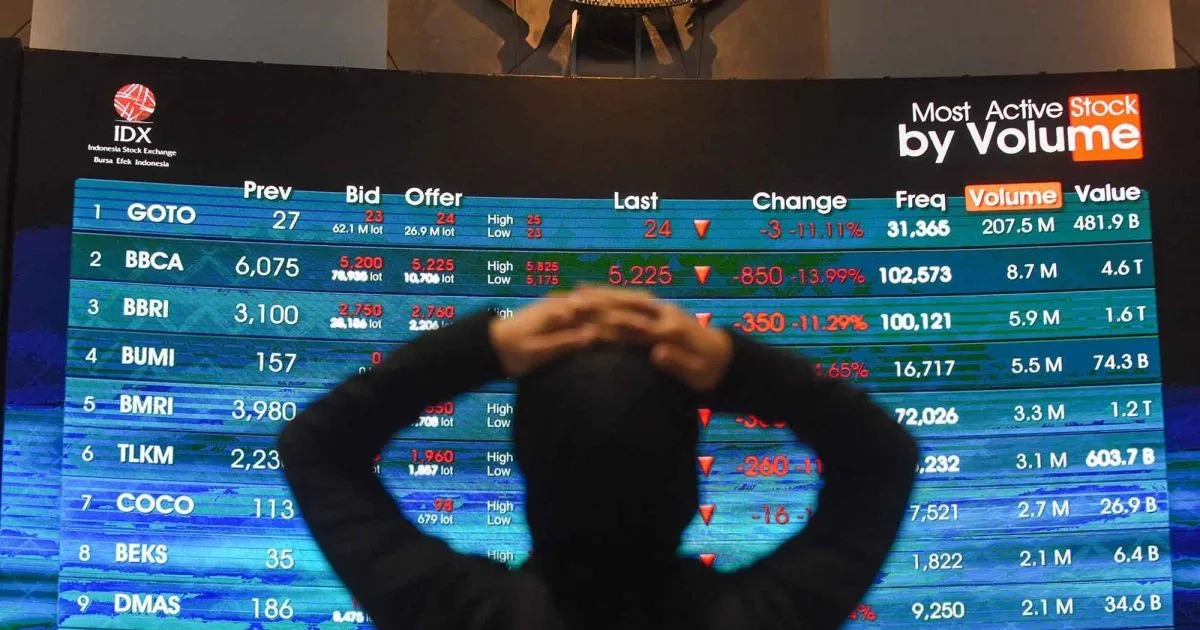
Indonesia stocks plunged more than 10% on Friday after MSCI proposed moving the country from emerging-market to standalone status, a change that could remove Indonesian shares from widely followed global benchmarks.
The Jakarta Composite Index opened down 8.01% at 5,393.92, triggering a 30-minute trading halt. It then extended the decline to 10.64% at 5,233, according to contemporaneous market reports. The move was the market's steepest intraday fall since 1998.
The sell-off followed MSCI's October 15 consultation announcement. No reclassification has been decided: feedback remains open until April 30, 2027, and MSCI says it will announce a final decision by June 30, 2027.
Indonesia Stocks Plunge as Trading Is Halted
Antara documented the opening halt at the Indonesia Stock Exchange in Jakarta. The benchmark had closed Thursday at 5,863.78 before losing 469.86 points at the Friday open.
Losses deepened after trading resumed. An Associated Press market report said the index fell more than 10%, while reports later in the session placed the drop above 11%. These are intraday readings and can differ from the eventual close.
The decline stood out against a broader rebound in Asian technology shares. South Korea's KOSPI rose 3.6% after the previous day's 7.6% drop, while Japan's Nikkei 225 gained 1.9%. That divergence points to a country-specific shock in Indonesia rather than a uniform regional sell-off.
Why MSCI Is Considering Standalone Status
MSCI said market participants continue to report persistent opacity in shareholding structures, suspected coordinated trading and insufficient evidence of meaningful enforcement. It concluded that Indonesia's continued emerging-market classification was no longer appropriate.
Indonesia had announced reforms including disclosure of shareholders owning more than 1%, more detailed investor classifications, reporting for highly concentrated ownership and a roadmap to raise minimum free float to 15%. MSCI said investors had not seen consistent progress or a sustained material impact across the market.
The proposed move is more severe than the frontier-market review signalled earlier in 2026. MSCI said feedback suggested frontier status would not fully reflect the depth of the market problems. A standalone classification keeps a market outside both the MSCI Emerging Markets Index and the MSCI Frontier Markets Index.
What a Downgrade Could Mean for Investors
MSCI indexes guide allocations for funds that track benchmarks and for active managers that measure performance against them. Removing Indonesia from emerging-market indexes could therefore force benchmark-linked portfolios to reduce exposure and prompt other investors to reassess liquidity and governance risks.
The risk is prospective. The consultation itself does not require an immediate removal, and the eventual fund flows will depend on MSCI's final decision, implementation timetable and the composition of affected indexes. Indonesia's authorities have until next year to present evidence of improved market governance and functioning.
MSCI is keeping its existing freeze on some index changes for Indonesian securities. It will not raise foreign inclusion factors or share counts, add stocks to the MSCI Indonesia Investable Market Index, or move securities into larger size segments while the freeze remains in place.
Indonesia's Response Becomes the Next Market Test
The Indonesia Stock Exchange said it would seek clarification on MSCI's assessment. Authorities have defended reforms introduced this year, including the transparency measures described in an April statement from the Financial Services Authority.
Friday's plunge shows that investors want evidence of enforcement, not only announced rules. The next signals are a detailed regulatory response, foreign-flow data after the halt and whether the benchmark stabilises once the initial forced selling passes.
The episode also follows a volatile week for Asian markets. BullBuzz reported the KOSPI's 7.6% chip-led plunge, an earlier regional sell-off as oil traded near $106, and TSMC's record quarterly profit. Indonesia's shock is different: the immediate trigger is confidence in the structure and oversight of its own equity market.
Banner: Visitors monitor falling shares at the Indonesia Stock Exchange in Jakarta on October 16, 2026. Antara Foto/Indrianto Eko Suwarso.