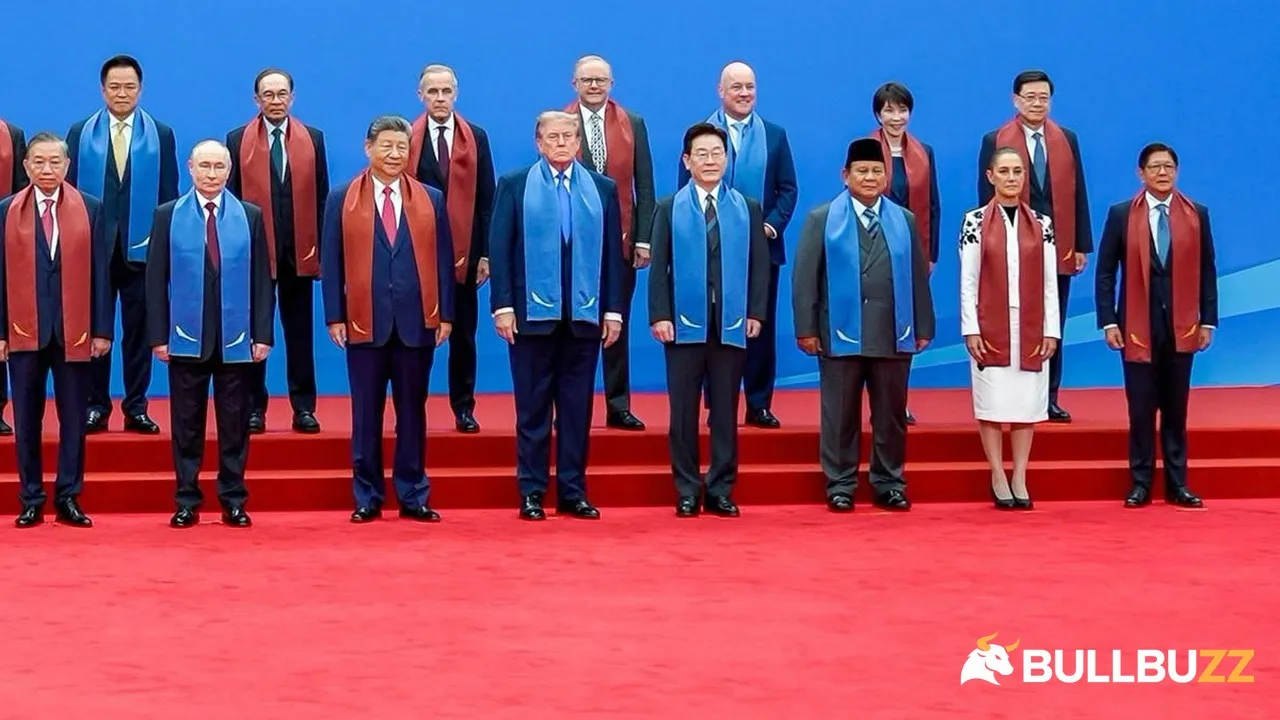
Donald Trump, Xi Jinping and Vladimir Putin ended the first-ever trilateral meeting of the leaders of the United States, China and Russia on Thursday evening with no agreement on nuclear arms, Ukraine or Iran, after about 90 minutes of talks at a lakeside villa in Shenzhen.
The meeting, held on the sidelines of the Asia-Pacific Economic Cooperation (APEC) summit, concluded at 6:01 p.m. MYT, Chinese state broadcaster CCTV reported, and produced no joint statement. It was the first time the three leaders had sat down together as a trio, and the first time the sitting leaders of the world's three largest nuclear powers had met in one room.
Nuclear arms dominated the public remarks before the doors closed. Trump said the three countries were "uniquely positioned" to discuss reducing the number of nuclear weapons in the world and lessening the risk they are ever used, while acknowledging that persuading countries to give up their arsenals was a "very hard thing to do". Xi said a nuclear war "cannot be won and must never be fought", and called for every effort to prevent one, to adhere to the Treaty on the Non-Proliferation of Nuclear Weapons and to maintain global strategic stability. Putin said constructive cooperation between the three countries could play a vital role in strengthening global stability, and that they shared responsibility for international peace and security. WION reported the opening remarks also covered the war in Ukraine, and Trump named Iran on proliferation.
Trilateral summit ends with no agreement
The session began at 4:16 p.m. MYT at the Kylin Villa, a lakeside state guesthouse in Shenzhen, about an hour later than scheduled, after the three leaders posed for photographs on a stage carrying the words "China-Russia-US Shenzhen Summit" in Chinese, Russian and English. Xi, who hosted the meeting, called it "groundbreaking", said major powers bore special responsibilities, and said China had advanced its partnership with Russia "for a new era" while building a "constructive and strategically stable relationship" with the United States, according to CCTV. Nikkei Asia reported that Putin left the venue at 6:23 p.m. MYT without making any media statements, and Trump boarded Air Force One and left China on Thursday evening.
The absence of a deal was not a surprise. Expectations had been low from the start: despite Trump's optimism that the three leaders could still "get something done", no agreement of any kind had been expected. The meeting took place nine months after New START, the last treaty capping American and Russian strategic arsenals, expired in February, leaving no binding limits on the world's two largest nuclear arsenals for the first time in more than half a century. China has long said it is neither fair nor realistic to ask it to join a replacement while its arsenal remains far smaller than the other two.
Bilaterals before the trilateral
The three-way session was the last of three meetings in a single day. Trump and Putin had met separately for about 40 minutes in the morning, with the Kremlin saying Ukraine was the main topic, and Trump later said he believed progress was being made towards ending the war. "Dialogue is the only way to resolve the conflict," he said. Ukraine had earlier expressed concern about major powers making decisions that could affect its future without its participation.
Trump's bilateral with Xi ended at 2:57 p.m. MYT. According to the Chinese readout, Xi said the relationship was "stable and trending positively" and the two sides agreed to develop an "action plan" for what Beijing called "constructive strategic stability". The readout made no mention of extending the trade truce between the two countries, which is set to expire on 10 January 2027, even as China vowed countermeasures over new US curbs on remote access to advanced AI chips that took effect on Thursday. On Taiwan, Xi urged Washington to "do the right thing to avoid major setbacks", and Xinhua reported that Trump assured Xi the United States "does not support 'Taiwan independence'". Xi also said artificial intelligence should remain under human control, and the two sides agreed to coordinate on AI security risks.
Why the meeting still matters
The symbolism was impossible to miss. The gathering drew comparisons with the 1945 Yalta conference, where the leaders of the United States, Britain and the Soviet Union discussed the post-war order, and the APEC family photograph on Thursday morning showed Xi at the centre, flanked by Putin and Trump.
What the meeting did not do is change any of the conflicts on its agenda. The war in Ukraine continues, the war involving Iran and the attacks on shipping through the Strait of Hormuz continue to threaten energy flows, and oil prices have slid this week as US crude stocks jumped and surplus fears grew. The trade truce between the United States and China still expires in January with no extension announced, and the new American chip curbs are already in force.
For now, the trilateral's only concrete product is the precedent itself: the three leaders have now met, talked about nuclear weapons face to face, and left the door open to doing so again. Whether that conversation becomes a channel, or remains a souvenir photograph, will be decided by what each capital does next.